
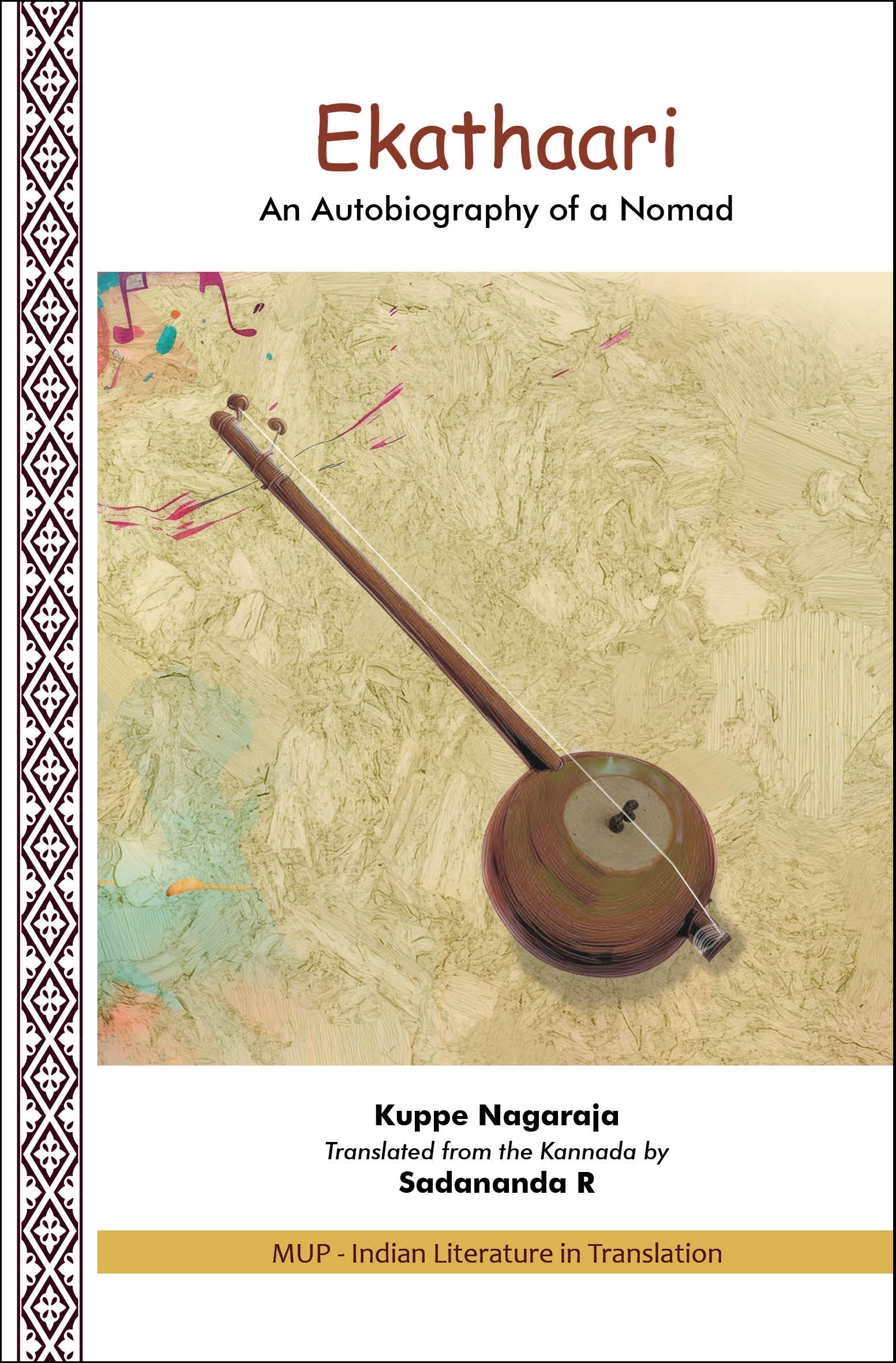
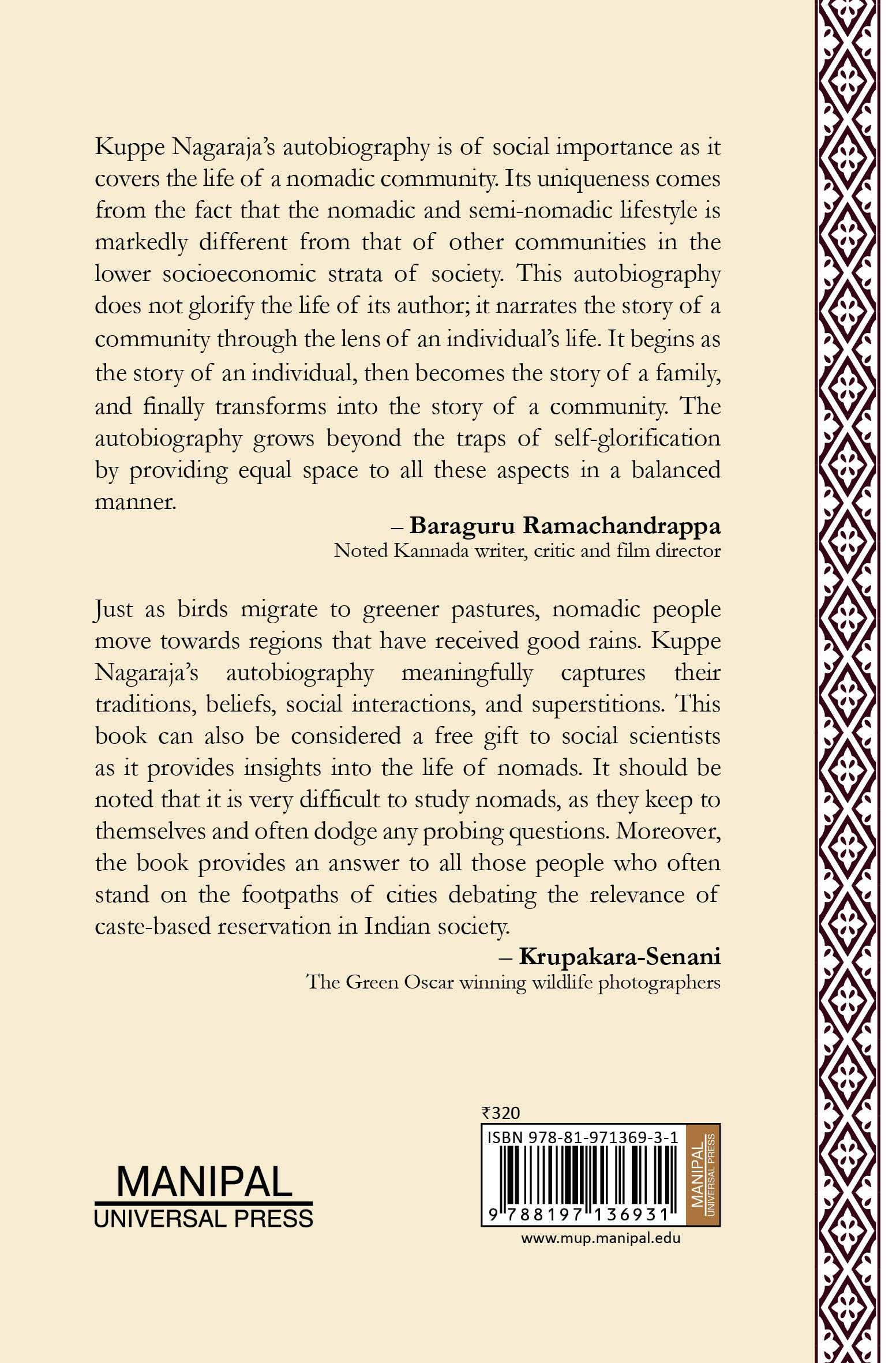
Ekathaari: An Autobiography of a Nomad
₹320.00
Author: Kuppe Nagaraja, Translator: Sadananda R
Kuppe Nagaraja’s autobiography is of social importance as it covers the life of a nomadic community. Its uniqueness comes from the fact that the nomadic and semi-nomadic lifestyle is markedly different from that of other communities in the lower socioeconomic strata of society. This autobiography does not glorify the life of its author; it narrates the story of a community through the lens of an individual’s life. It begins as the story of an individual, then becomes the story of a family, and finally transforms into the story of a community. The autobiography grows beyond the traps of self-glorification by providing equal space to all these aspects in a balancedmanner.
– Baraguru Ramachandrappa
Noted Kannada writer, critic and film director
Just as birds migrate to greener pastures, nomadic people move towards regions that have received good rains. Kuppe Nagaraja’s autobiography meaningfully captures their traditions, beliefs, social interactions, and superstitions. This book can also be considered a free gift to social scientists as it provides insights into the life of nomads. It should be noted that it is very difficult to study nomads, as they keep to themselves and often dodge any probing questions. Moreover,
the book provides an answer to all those people who often stand on the footpaths of cities debating the relevance of caste-based reservation in Indian society.
– Krupakara-Senani
The Green Oscar winning wildlife photographers
interested customers may write to us at mup@manipal.edu about purchasing the book.
Also available on

| Format | |
|---|---|
| Author |
Related products
-
Unheard Sounds Flow On
₹315.00Author: K Mahalinga, Translator: T K Ravindran
In spite of being one of the oldest members of the Dravidian family of languages, Tulu, unfortunately, has not yet found the recognition that it richly deserves in the modern world. Since modernity privileges the written over the spoken, the Tulu language that is abundantly blessed with oral literature has been placed on the fringes of modern literary world. Ironically, Tulu is still engaged in a desperate fight for official status in a country that boasts of its cultural and linguistic diversity. The motives behind the translation of Nanajjer Sude Tirgayer, hailed as the first modern Tulu novel, into English refuse to remain apolitical in this context.
The novel, which has already been translated into Kannada, Konkani and Malayalam, beautifully captures the pulse of rusticity that characterizes the life of a village community that lived its life with its love-hate relationship with nature, more than 75 years ago in a Tulu speaking village in the south-western part of Karnataka. Besides bringing alive the socio-cultural practices that find their articulation through the natural linguistic plurality ingrained in the village psyche, the novel touches upon the duality of human nature that leaves man perennially condemned to an inner crisis.
Interested customers may write to us at mup@manipal.edu about purchasing the book.
Also available on
-
Tapaalu Mani
₹140.00Author: Rabhindranath Tagore, Translator: Mounesh Badiger
ರಾಷ್ಟ್ರಕವಿ ರವೀಂದ್ರನಾಥ ಠಾಕೂರರ ‘ಡಾಕ್ ಘರ್’ ಬಹಳ ಪ್ರಸಿದ್ಧ ನಾಟಕ. ಮಗುವಿನ ಮನೋದೈಹಿಕ ಸಾಧ್ಯತೆಗಳನ್ನು ಕಲೆಯ ಸೂಕ್ಷ್ಮಕಣ್ಣಿನಿಂದ ನೋಡುವ ಎರಡಂಕದ ಪುಟ್ಟ ನಾಟಕವಿದು. ಇದು ಸೃಷ್ಟಿಸುವ ಮಾಯಾವಾಸ್ತವ ಬಹಳ ಅಪರೂಪವಾದದ್ದು. ಇದರ ಮುಖ್ಯ ಪಾತ್ರ ಮಗುವೇ ಆಗಿದ್ದರೂ ಇದರ ವಸ್ತು ಮಕ್ಕಳಿಗಳಿಂತ ಹೆಚ್ಚಾಗಿ ದೊಡ್ಡವರಿಗೇ ಅನ್ವಯವಾಗುವಂತಿದೆ. ಮೌನೇಶ ಬಡಿಗೇರರು ಇದನ್ನು ಉತ್ತರಕರ್ನಾಟಕದ ಭಾಷೆಗೆ ತಂದು ಕನ್ನಡದ ನಾಟಕವೇ ಎನ್ನುವಷ್ಟು ರೂಪಾಂತರಿಸಿದ್ದಾರೆ. ಇದರ ಪ್ರಯೋಗದ ಹೊಸ ಹೊಸ ಸಾಧ್ಯತೆಗಳನ್ನು ಕನ್ನಡ ರಂಗಭೂಮಿ ಇನ್ನೂ ಶೋಧಿಸಬೇಕಿದೆ.
Interested readers may write to us at mup@manipal.edu about purchasing the book.
Also available on
-
Swapna Saraswatha
₹530.00Author: Gopalakrishna Pai Translator: Sumathi Shenoy, M R Rakshith, Savita Sastri
Swapna Saraswatha is the saga of migration of a community called Saraswaths in the west coast of India, extending from Goa to the south of Mangalore. It captures the dominance of a colonial power over the region that began with the entry of the Portuguese about four hundred years ago. The novel is a graphic description of the displacement of this strongly-rooted community which saw its resurrection in a new area. In the course of its narrative, the novel traces the gradual changes in the structure of the family that moved from a closely knit joint family of the bygone era to the nuclear family. It also deals with the factors that are responsible for the change in value systems of individuals in the wake of such paradigm shifts. With its vast canvas, it remarkably weaves fiction with myth and history, peppered with cultural details and linguistic nuances. The narration in Swapna Saraswatha progresses in the form of an epic detailing the story of nine generations spread over a period of two hundred and fifty years from 1510 to about 1760. It encompasses more than a hundred and fifty characters which include Hindus, Muslims, Christians, chieftains, traders, farmers, priests and black magicians, and covers a range of themes spread across folk tales, legends, armies, myths and a sprinkling of history.
-
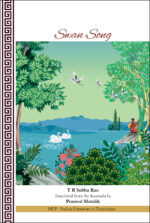
Swan Song
₹320.00Author: T R Subba Rao| Translator: Pramod Mutalik
Swan Song is the poignant tale of Venkatasubbiah, a legendary musician from 18th century Chitradurga. Written by renowned Kannada author Late Shri T R Subba Rao (TaRaSu) and translated into English by Prof Pramod Mutalik, the novel explores the extraordinary journey of an artist whose unwavering dedication to his craft defines his life.
The author weaves together perspectives from people of varied backgrounds to reconstruct Venkatasubbiah’s story, revealing his innate musical genius and determination. It narrates the tale of a musician’s steadfast devotion to art against all odds.
The narrative takes a dramatic turn when Venkatasubbiah defies Tippu Sultan’s order to perform in his palace. To protect the dignity of his art, he sacrifices his ability to sing by cutting off his tongue. Undeterred, he continues to produce swaras through his nose, earning him the metaphorical title of the swan. His life ends while performing, leaving an unforgettable legacy of self-respect and artistic integrity.
Interested readers may write to us at mup@manipal.edu about purchasing the book.Also available on
-

BAKA – Collection of Two Plays
₹340.00Author: M S Keshava Prabhu, Translator: L V Shantakumari
Baka dramatizes the episode of Bakasura, from the Indian epic, Mahabharata. Baka is a cannibal demon that terrorizes a village with its horrifying attacks. The king of the village strikes an agreement with the demon, putting its people in peril. They live in constant fear for years until the sudden arrival of a hero changes everything.
A theatrical and evocative narration, this play satirically mirrors society’s greed and irresponsibility. It depicts power struggles through the conflict that arises between Baka the demon, the cowardly king, and the oppressed people.Interested customers may write to us at mup@manipal.edu about purchasing the book.Also available on -
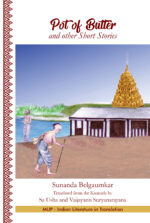
Pot of Butter and other short stories
₹250.00Author: Sunanda Belgaumkar Translator: Sa Usha, Vaijayanti Suryanarayana
Pot of Butter and other Short Stories is a collection of nine short stories, originally composed by Sunanda Belgaumkar in Kannada, handpicked and translated from her collections – Kajjaya and Koduvudenu Kombudenu. The bulk of her literary work including the stories in this book are inspired by the experiences in her early life, in the rustic and robust atmosphere of Dharwad. Her stories are predominantly semiautobiographical, laced with a liberal dose of artistic freedom.
This collection weaves together her writings on the underprivileged and marginalized as seen from the comfort of her palatial home, but rendered with compassion and empathy. Often, we find her narrative infused with self-directed questions such as, “What if I was in her shoes? ” or “Could that have been me? ” These stories are reflections on human nature, suffering, and destiny. There is hope, there is despair. There is love, there is longing. There is defeat, and there is triumph. In her stories, an oft-recurring metaphor for picking up one’s life after loss is a scorching summer followed by a torrential downpour and subsequently a plant springing to life.
As a translation, this book attempts to introduce Sunanda Belgaumkar’s literary and artistic creations to the non-Kannada reader, retaining as much of the indigenous elements of the original writings as possible. In doing so, it seeks to preserve the cultural climate of North Karnataka as it was around fifty years ago.
Interested readers may write to us at mup@manipal.edu about purchasing the book.
Also available on
-
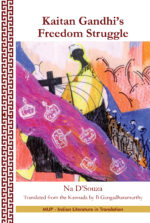
Kaitan Gandhi’s Freedom Struggle
₹280.00Author: Na D’Souza Translator: B Gangadharamurthy
Kaitan Gandhiya Swatantrya Horata is one of the very few novels written in Kannada on the Gandhian phase of the Indian freedom struggle. It is not globally unknown that Gandhi not only changed the idiom of the struggle and successfully experimented his lifetime-belief in non-violence on the vast canvas but also made it decisively inclusive. Kaitan Gandhi’s Freedom Struggle thematically illuminates these two crucial aspects of the great struggle and grapples with the naked truth as Charles, the priest in the novel revealingly says,The rulers, whosoever it is, are rulers. Caste, colour, or country does not matter to them. All are wicked. Like in all true works of realist literature, the author, here too, creatively blends the individual, the social, and the historical in such a way that the novel poignantly unfolds the true spirit of quest for freedom and humanity.
Interested readers may write to us at mup@manipal.edu about purchasing the book.
Also available on
-
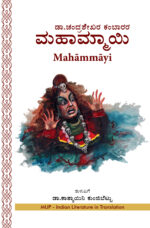
Mahāmmāyi
₹195.00Author: Chandrasekhara Kambara, Translator: Kathyayini Kunjibettu
Mahāmmāyi is the story of the legend of Shatavithaayi – the Goddess of death, and her adopted son Sambhashiva. Out of affection for her son, Goddess Shatavithaayi blesses him with the “power of life”. The blessing was that death will evade the people who are treated by Sambashiva. But a certain condition set by Shatavithaayi forbade him from healing every ill man. The condition was that, if Shatavithaayi stood on the right side of the patient, Sambhashiva could treat that person and he would live; but, if she stood on the left side of the patient, he should not treat that person as his death was inevitable. Through a distinct method of story-telling, the story follows the life of Sambhashiva as he begins to question the ideas of fate and destiny. Thus, the conflict between fate and human efforts to change that fate is vividly described in this play.Interested readers may write to us at mup@manipal.edu about purchasing the book.
Also available on