
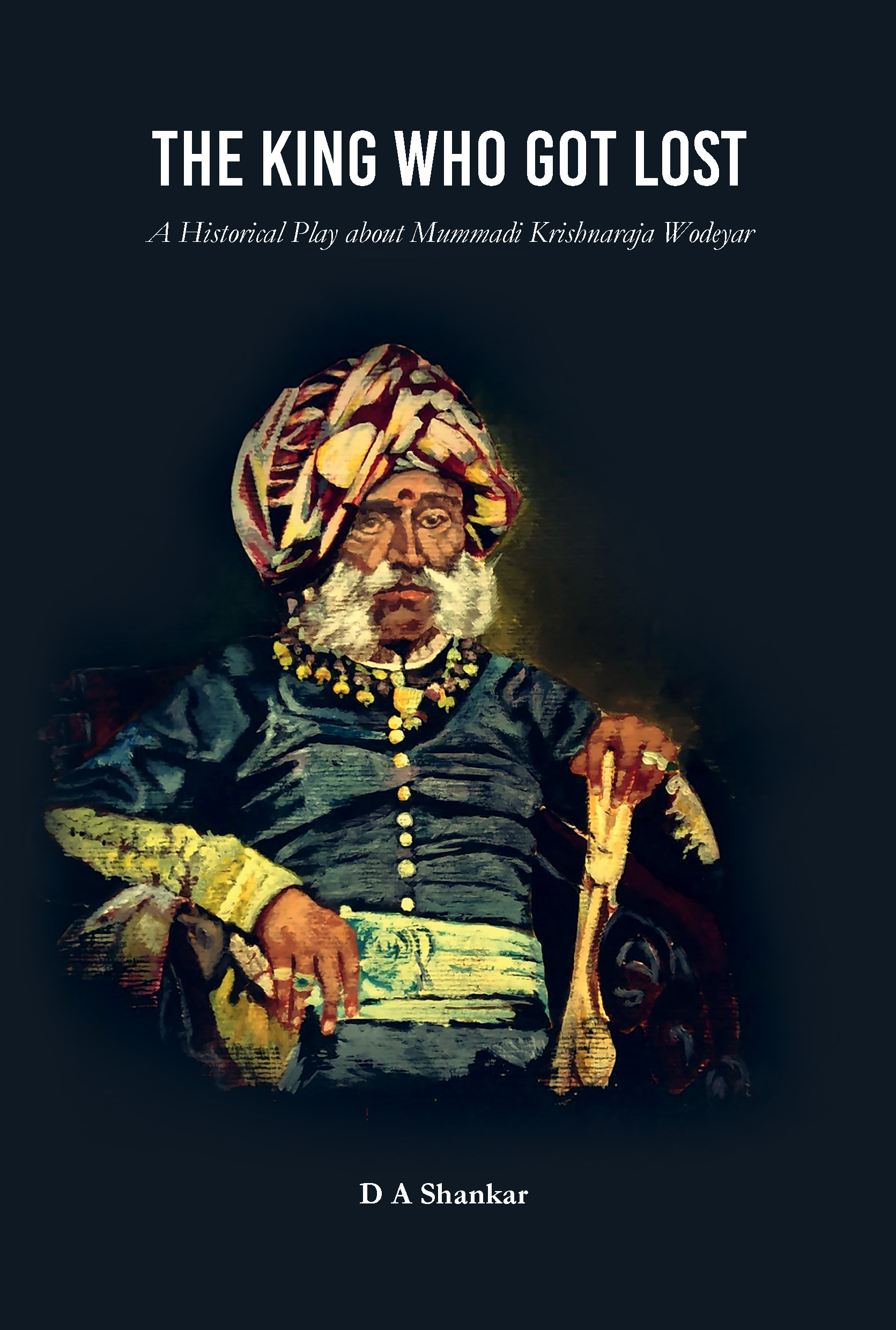
The King Who Got Lost: A Historical Play about Mummadi Krishnaraja Wodeyar
₹200.00
Author: D A Shankar
Young Mummadi, put on the throne by the British after the last Mysore war in 1799, was brought up under the watchful guidance of the far-sighted and shrewd Dowager Maharani Lakshmammanni. After falling into the hands of the powerful and politically experienced Dewan Purnaiah, he had a tortuous and tortured life. The young prince was never able to outgrow the influence of two of these mentors. To add to this, Mummadi, fell prey to an easy and rather voluptuous life. He was married but in addition to his many wedded consorts, he was caught in the spying and quarrelsome domestic life. Mummadi could never, despite valiant efforts, free himself and grow into a self-confident king.
The pressures of the ruthless British administration and the local, disruptive, and rebellious chieftains made Mummadi’s life a sad, tragic tale bordering on the ridiculous and the pathetic.
Interested overseas customers may write to us at mup@manipal.edu about purchasing the book.
|
Also available on
|
| Format |
|---|
Customer Reviews
There are no reviews yet.
Related products
-
Reliving the memories of an Indian forester: Memoir of S Shyam Sunder
₹450.00Editor: Shiv Someshwar
Shyam Sunder’s memoir is a series of vignettes, from numerous comedic to a tragic few. The life narrated is varied and never short of excitement – being ten yards from a charging tusker or a foot away from a King Cobra; defying orders of the chief minister; being hauled up for contempt of the high court, and discussing with Indira Gandhi the best way to eat avocados. Possessed of wit and passion, the narration lays bare the hubris of popular discourse on noble forest livelihoods, and unflinchingly narrates neglect of rural communities, as well as of forests, at times by the callous imposition of rules and regulations.
Interested readers may write to us at mup@manipal.edu about purchasing the book.
Also available on

-
Valmiki Ramayana – Critical Essays
₹250.00Author: M R Parameswaran
This book critically engages with several important events and statements found in Valmiki’s epic poem, the Ramayana composed over 2500 years ago. Though certain methods were followed to preserve the Vedic texts, no serious methods were adopted to preserve the text of Ramayana. The poem spread to all parts of India and beyond through narrators of the epic who sometimes added their own explanatory verses to conform to local customs and traditions. In the second half of the 20th century, scholars at the Baroda Oriental Research Institute, after many years of labour and examination of over 2000 different manuscripts, compiled what is now accepted as the most reliable version of the poem. Based on this critical edition, a condensed English version by Dr Parameswaran was earlier published by the Manipal University Press. In the present book, Dr Parameswaran reviews the critical interpretations of scholars like Sheldon Pollock, R P Goldman and Wendy Doniger and has analytic responses to many unanswered questions. About the book: Dr M R Parameswaran has taught Mathematics as well as Sanskrit at the University of Manitoba in Winnipeg, Canada. His work Studies in Srivaishnavism, has been well received by academic scholars and Srivaishnavas.
Interested readers may write to us at mup@manipal.edu about purchasing the book.Also available on
-

Post Googlism and Other Short Stories
₹350.00Author: R C Natarajan
This collection of short stories is for the fast-paced millennials, whom the author calls “The Post Googlist Generation” who want everything hastily, at their finger-tips and on the go. The language has also shrunk in size to allow the pace. The world-view of this generation is that what cannot be done through an app cannot and should not be done. Their expectations of a story are a striking start, a quickly built middle and an interesting end. Stories in the collection seek to meet these expectations of this generation talking to them in their own language. They also echo the changing lives and changing aspirations of the time.
Interested readers may write to us at mup@manipal.edu about purchasing the book.
Also available on
-
Dhvani and Epiphany: Essays in Criticism
₹270.00Author: Prabhaker Acharya
Dhvani and Epiphany examines the work of major Indian poets like Nissim Ezekiel and Arun Kolatkar; the struggle of young poets to find an audience; and the art of fiction. But its main focus is on the nature of creativity. How does an artist communicate his meaning? What makes a work genuinely creative? Through a sensitive exploration of poetry- ranging from the simple poems of a child, Poorna Prajna, to the complex “Byzantium Poems” of Yeats- the first seven essays try to show how a poem comes to life when it speaks to us and we listen to its dhvani and respond.
Even in fiction, it is not all realism. There is irony in exploring the paradoxical nature of reality; events taking on symbolic overtones; and epiphany, moments of illumination and insights – when surprising correspondences are seen. Writers cannot surprise and delight their audience if they themselves are not surprised and delighted by such insights.
Interested readers may write to us at mup@manipal.edu about purchasing the book.
Also available on
-
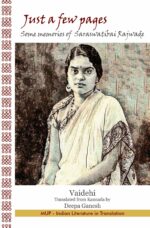
Just a few pages: Some Memories of Saraswatibai Rajwade
₹210.00Author: Vaidehi, Translator: Deepa Ganesh
This book is a coming together of two women writers of modern Kannada literature; one from its early period, the other, a contemporary. Saraswati Bai Rajwade, the early writer, became a fable, a mythology, leaving behind only the shadows of her writing. Vaidehi, the contemporary writer, reinvents Rajwade from the folds of history and gives her a life in the present. Saraswati Bai Rajwade was born into a poor family in the Dakshina Kannada of yore. By chance, she stepped into theatre and later into films. But all the glory that came to her unexpectedly, vanished just as suddenly. She later became the wife of a rich and high official, travelled abroad and underwent immense suffering. In her pain and loneliness, she took to books and also began to write and attained glory as a writer. In the last years of her life, she returned to a life of austerity and anonymity. Vaidehi has collected bits and pieces from her life and writing, presenting before us a unique tapestry. In this tapestry, Vaidehi?s perceptions criss-cross with Rajwade?s life and writing. Art does not reside in the object, but in its close encounter with life. This work unfolds before us as a grand illustration of such twin narratives.
Interested readers may write to us at mup@manipal.edu about purchasing the book.
Also available on
-
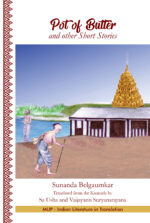
Pot of Butter and other short stories
₹250.00Author: Sunanda Belgaumkar Translator: Sa Usha, Vaijayanti Suryanarayana
Pot of Butter and other Short Stories is a collection of nine short stories, originally composed by Sunanda Belgaumkar in Kannada, handpicked and translated from her collections – Kajjaya and Koduvudenu Kombudenu. The bulk of her literary work including the stories in this book are inspired by the experiences in her early life, in the rustic and robust atmosphere of Dharwad. Her stories are predominantly semiautobiographical, laced with a liberal dose of artistic freedom.
This collection weaves together her writings on the underprivileged and marginalized as seen from the comfort of her palatial home, but rendered with compassion and empathy. Often, we find her narrative infused with self-directed questions such as, “What if I was in her shoes? ” or “Could that have been me? ” These stories are reflections on human nature, suffering, and destiny. There is hope, there is despair. There is love, there is longing. There is defeat, and there is triumph. In her stories, an oft-recurring metaphor for picking up one’s life after loss is a scorching summer followed by a torrential downpour and subsequently a plant springing to life.
As a translation, this book attempts to introduce Sunanda Belgaumkar’s literary and artistic creations to the non-Kannada reader, retaining as much of the indigenous elements of the original writings as possible. In doing so, it seeks to preserve the cultural climate of North Karnataka as it was around fifty years ago.
Interested readers may write to us at mup@manipal.edu about purchasing the book.
Also available on
-

The Practice of Geopolitics
₹850.00Author: M D Nalapat
Intended to be a Practioner’s Guide to Geopolitics, the book provides a look into the thought processes that generate correct and timely analysis of global events. Geopolitics needs to weave within its analytical grasp economics, society, strategy and even culture, as the science deals with overall national capabilities as well as the mutal synergy and frictions between nations. Although a broad range of subjects has been covered in the book, each is anchored in the ground reality of events having a profound impact on the lives of citizens and on world events. The growing interconnectedness of the globe has resulted in a need to do away with the popular west centric models of international relations and to view events not through that single prism but from a holistic viewpoint that accepts the relevance and maturity of different histories and geographies. What the book provides is an alternative Weltanschauung to the dominant models of geopolitical analysis, so that the science is enabled to cross beyond the narrow boundaries which have confined. The scope and applicability of its analysis. The rise of Asia needs a geopolitical vision unique to the continent, and this is what has been provided by Professor Nalapat.
Interested readers may write to us at mup@manipal.edu about purchasing the book.
Also available on
-
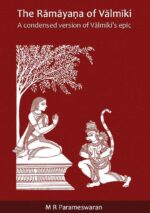
The Ramayana of Valmiki: A condensed version of Valmiki’s epic
₹340.00Author: M R Parameswaran
The world’s greatest epic poem Valmikiramayana, composed over 2,500 years ago, is loved by countless millions of men and women of all religions. The present book is the first condensed version in English of the most reliable version of Valmikiramayana, the Critical Edition prepared by Baroda Oriental Research Institute, India.
Interested readers may write to us at mup@manipal.edu about purchasing the book.Also available on
Be the first to review “The King Who Got Lost: A Historical Play about Mummadi Krishnaraja Wodeyar”
You must be logged in to post a review.