
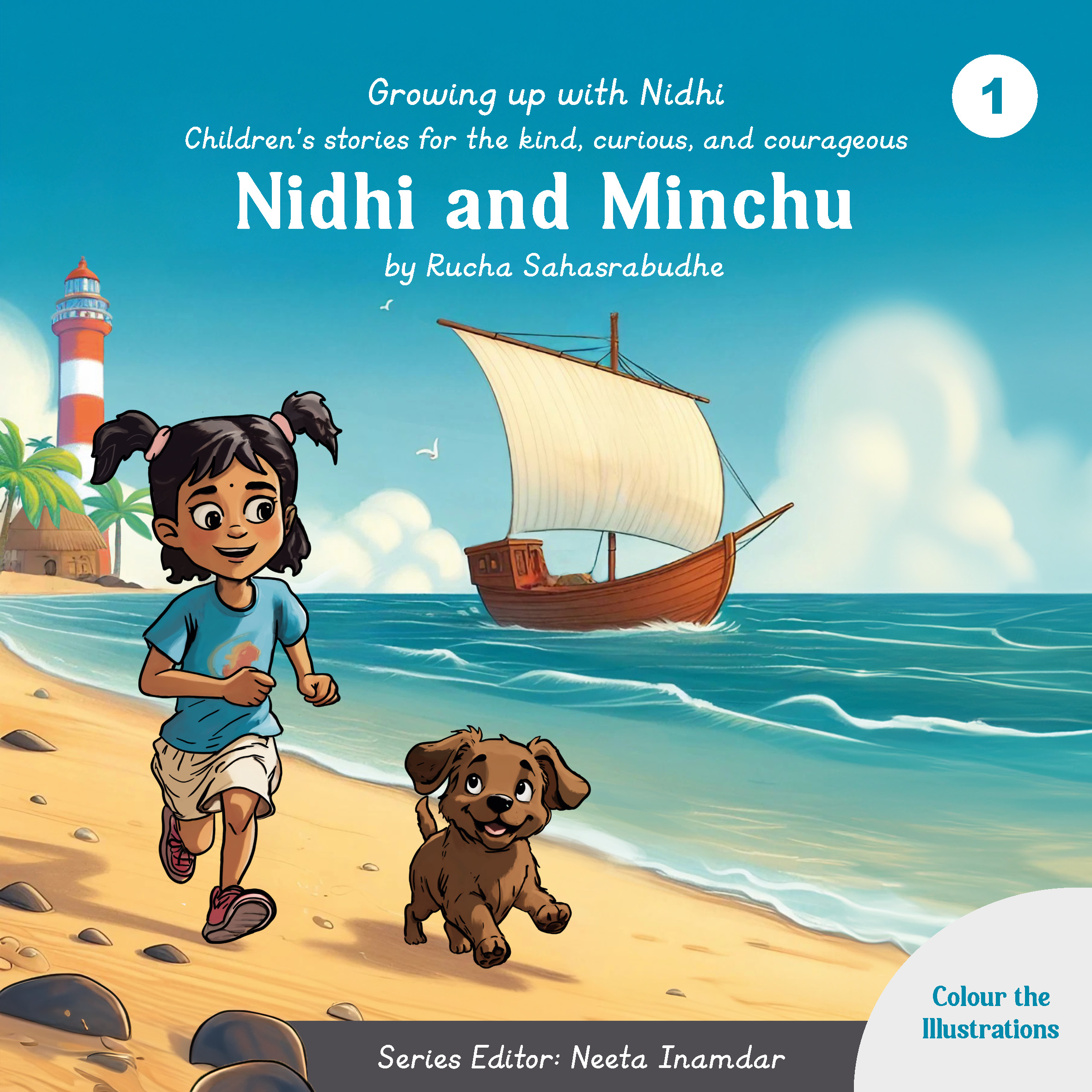
Growing up with Nidhi: Book 1 – Nidhi and Minchu
₹280.00
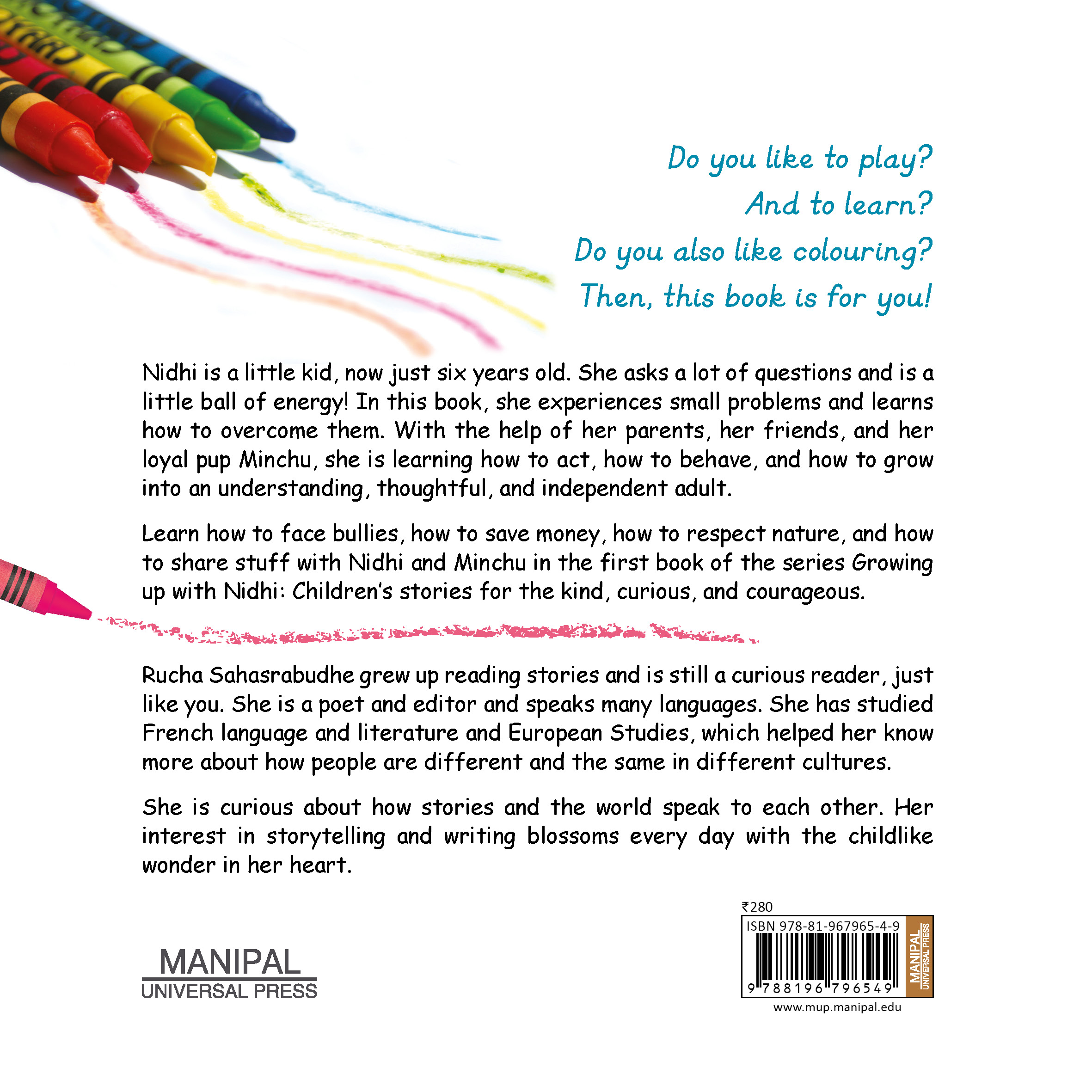
Do you like to play?
And to learn?
Do you also like colouring?
Then, this book is for you!
Nidhi is a little kid, now just six years old. She asks a lot of questions and is a little ball of energy! In this book, she experiences small problems and learns how to overcome them. With the help of her parents, her friends, and her loyal pup Minchu, she is learning how to act, how to behave, and how to grow into an understanding, thoughtful, and independent adult.
Interested readers may write to us at mup@manipal.edu about purchasing the book.
|
Also available on |
| Format |
|---|
Customer Reviews
There are no reviews yet.
Related products
-
History of Private Banking in South Canara District (1906-69)
₹580.00Author: Amol Agrawal
This book explores the unique history of banking in India’s South Canara district. The origin and growth of banking in this region played a significant role in the history of Indian banking, but its contributions remain under-researched. The banks of South Canara are particularly noteworthy as they implemented financially inclusive practices long before they were made mandatory during the nationalization of banks in 1969.
The other sixteen nationalized banks were predominantly from the four metropolitan cities Bombay, Delhi, Calcutta, and Madras. The banks of South Canara warrant special attention as the prevalence of this establishment came about in a comparatively remote district. The banks also introduced and continued to offer many schemes for the benefit of the people in the region. This book traces the evolution of banks from the South Canara and how they have contributed to the rich local administrative history of the region.
Interested readers may write to us at mup@manipal.edu about purchasing the book.
Also available on 
eBook available on 
-
The Princely States and the Making of Modern India
₹640.00Editors: D A Prasanna, K Sadashiva
India’s Princely States have enjoyed only a minor place in the narrative of modern nationhood. Certain Princely States used the dynamics of transfer of power to carve autonomy from the colonial British to advance their societies. Some of the Princely States modernized their education, public health and industrial sectors way ahead of the British administered territories. Prof Washbrook provides a macro picture of the dynamics in the Princely States of South India and sees a distinctive and indigenous form of modernity. Hierarchy, religion, heredity and caste were not obliterated for rationalism and secularism. As socialism and pseudo-secularism are fading away, the significance of the indigenous forms of modernity of the Princely States becomes more relevant to understand India in the 21st century. Ten historian thought leaders provide an interesting perspective to make it a compelling read. K Sadashiva is the architect of this book. As he developed the theme and brought together historians from various parts of the world, an interesting tapestry was woven. He is a historian actively researching the Indian Union, the Princely States and the rise of political power of caste and class in independent India. D A Prasanna has an interest in history, visual art, public health and education. He has supported new initiatives in these fields and has actively nurtured ideas to result in outcomes.
Interested readers may write to us at mup@manipal.edu about purchasing the book.
Also available on
-
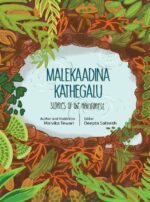
Malekaadina Kathegalu – Stories of the Rainforest
₹450.00Author: Malvika Tewari, Editor: Deepta Sateesh
Malekaadina Kathegalu is a fictional story set in the rich dense rainforest of Agumbe, narrating the journey of Nitya, a young girl who travels to the small village with her father, a conservationist. This book is the result of a research experiment responding to and reimagining the People’s Biodiversity Register (PBR), a tool used to document biological diversity of local communities. Set in the Western Ghats, the story weaves popular references like Malgudi Days in the narrative with the experiences of the people living in Agumbe, Karnataka.
To most people, the Western Ghats is a range of hills on the west coast of India with lush forests in the monsoon and a repository of minerals. It is also a UNESCO World Heritage site and a biodiversity hotspot. To the residents of Agumbe, it is much more: cultural relations, ritual practices, and connections with other-than-human sentient beings. The nature-culture understandings, which comprise of everyday practices of food, kitchen gardens, and medicinal practices, and wandering on foot are experienced by Nitya throughout the story.
Malekaadina Kathegalu reflects the realities and complexities surrounding countless changes in ancient ecologies due to pressures of rapid development, and the diverse aspirations of new generations in a time of environmental crisis. It records the rich diversity of other-than-human beings and material and atmospheric changes across time through primary research using creative mixed methods.
Interested customers may write to us at mup@manipal.edu about purchasing the book.
Also available on
-
A Modern Introduction to Madhva Philosophy
₹475.00The author has made this treatise on Madhva’s realistic school of Vedānta philosophy convincing to the modern mind by employing western logical apparatus in substantiating Madhva’s ideas. Following the Indian classical tradition, the author has examined the validity of Advaitavedānta, the Absolute Monism of Śaṅkara and Bhāskara as Pūrvapakṣa, and logically proved its inconsistencies. He has then established the Dvaitasiddhānta i.e., the Monotheistic Dualism of Madhva. He has successfully brought out the nuances of the realistic school of Indian philosophical thought in this work. A Modern Introduction to Mādhva Philosophy is Prof B H Kotabagi’s posthumous publication.
Interested customers may write to us at mup@manipal.edu about purchasing the book.
Also available on
-

Boatman! – Take these songs from me
₹1,800.00Authors: Gabriel Rosenstock, Masood Hussain
Boatman! take these songs from me is a compilation of mesmerizing artwork coupled with tankas. A tanka is an ancient Japanese form of poetry written in short five-line verses, with a total of 31 syllables. The painted reliefs are an aesthetic creation by Masood Hussain, who bases his artwork in this book on Mirza Ghalib’s couplets on the inevitability of grief. These works explore human suffering, the melancholy of life, and the visceral struggle against oppression..
These themes are contextualized in the poems, written by Gabriel Rosenstock, which speak of love, sacrifice, longing, and freedom. His poems also comprise an interesting orthographical inversion of the capital Y in ‘You’ and the lower case ‘i’, which subjectifies the reading experience through an outward focal lens, reflected in the play of light and hue in the paintings. The bilingual poems in Irish and English capture the essence of the paintings, ferrying the collection across to the reader. This poetically painted coffee table book is a ‘Boatman’ unto itself.Interested readers may write to us at mup@manipal.edu about purchasing the book.
Also available on
-
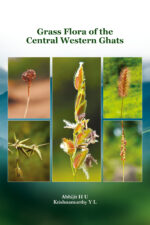
Grass Flora of the Central Western Ghats
₹3,000.00Authors: Abhijit H U, Krishnamurthy Y L
This comprehensive flora presents 231 wild grass taxa and eight cultivated taxa across 95 genera, including seven bamboo taxa, from the central Western Ghats of Karnataka. Among these, one variety is newly described to science, four species are newly recorded for the flora of Karnataka, and one grass species has a new locality record. It serves as an updated resource for the district grass floras of this region.
The book provides detailed species descriptions, artificial dichotomous keys, phenology, and distribution information at the global, national, and state levels. It also includes information on habitat, habit, and sample collection areas for all species recorded in the study. The inclusion of 194 photo plates depicting dissected grasses, spikelets, various habitats, and four bamboo illustrations represents a key feature of this work.Interested readers may write to us at mup@manipal.edu about purchasing the book.
Also available on
eBook available on
-
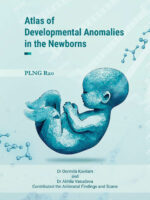
Atlas of Developmental Anomalies in the Newborns
₹2,000.00Author: PLNG Rao
Atlas of Developmental Anomalies in the Newborns is a clinically oriented, pictorial reference that includes a wide range of congenital anomalies seen in newborn babies. This book is based on decades of clinical experience and a large referral base. The book includes the classification of congenital anomalies, clinical explanations for each condition, and clinical and surgical photographs curated by the author, Dr PLNG Rao. It also includes guidance on prognosis and parental counselling to help clinicians decide on the next steps. It is designed as a resource that is useful for pediatricians, neonatologists, obstetricians, and pediatric surgeons. It focuses on recognizing, understanding, and clinically approaching congenital anomalies in newborns through visual documentation and concise explanations.
Interested readers, international readers and bulk buyers may write to us at mup@manipal.edu about purchasing the book.
Also available on
eBook available on
-
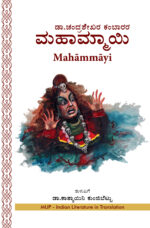
Mahāmmāyi
₹195.00Author: Chandrasekhara Kambara, Translator: Kathyayini Kunjibettu
Mahāmmāyi is the story of the legend of Shatavithaayi – the Goddess of death, and her adopted son Sambhashiva. Out of affection for her son, Goddess Shatavithaayi blesses him with the “power of life”. The blessing was that death will evade the people who are treated by Sambashiva. But a certain condition set by Shatavithaayi forbade him from healing every ill man. The condition was that, if Shatavithaayi stood on the right side of the patient, Sambhashiva could treat that person and he would live; but, if she stood on the left side of the patient, he should not treat that person as his death was inevitable. Through a distinct method of story-telling, the story follows the life of Sambhashiva as he begins to question the ideas of fate and destiny. Thus, the conflict between fate and human efforts to change that fate is vividly described in this play.Interested readers may write to us at mup@manipal.edu about purchasing the book.
Also available on
Be the first to review “Growing up with Nidhi: Book 1 – Nidhi and Minchu”
You must be logged in to post a review.