
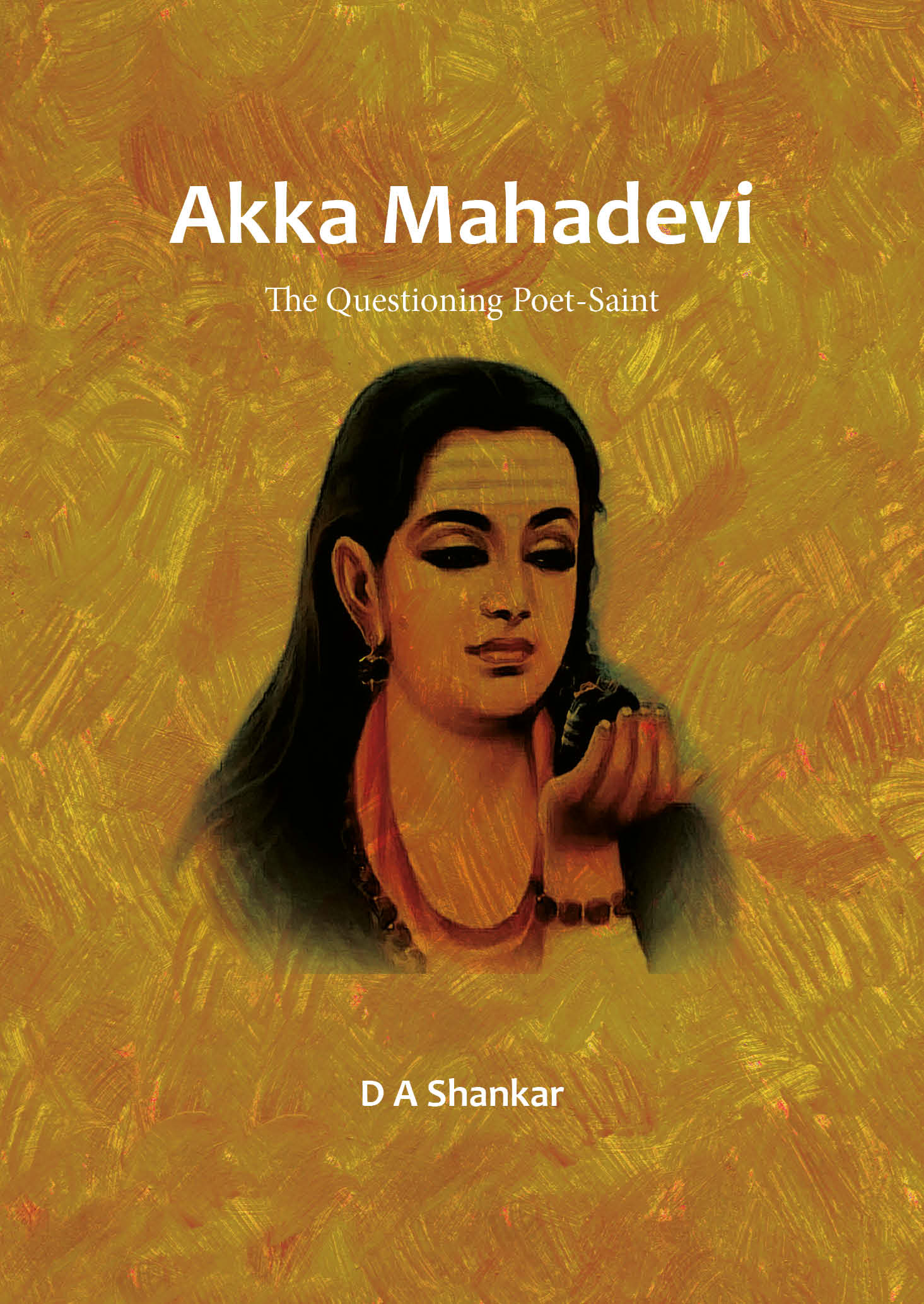
Akka Mahadevi, the questioning poet-saint
₹255.00
Author: D A Shankar
This book presents the mystical ruminations and literary excellence of Akka Mahadevi, the earliest example of a gender-liberated woman writer, credited with the composition of over four hundred and forty remarkably self-explorative Vachanas. Akka Mahadevi represents a powerfully authentic female voice of the radical, egalitarian Sharana Movement, which questioned the socially established barrier between genders and ushered in a world of socio-cultural equality.
In this book, the author explores the questioning spirit intrinsic to Akka Mahadevi’s life and writings, as she questions the widely held conventional norms: the traditional husband-wife relationship, her parents, elders; she questions Basavanna and Allama for their habituated patriarchal manner of speaking, and she bravely questions her personal deity whom she loves and adores. Apart from discerning a credible ‘history’ and background to Akka’s works, this book makes available a rendition of her selectively profound and memorable Vachana in modern English, that crosses the ?the gulf of language and the gulf of time.
Interested readers may write to us at mup@manipal.edu about purchasing the book.
Also available on

| Author | |
|---|---|
| Format |
Customer Reviews
There are no reviews yet.
Related products
-
Two Plays – The Sahyadri Saga and The World of Swayamvara
₹199.00Author: Akshara K V Translator: Jayanth Kodkani
These two plays negotiate with the real problems of contemporary India. If Sahyadri Kanda is about the ripples caused in the life of the people in a village on the Western Coast which will soon have a nuclear plant, Swayamvaraloka, is an allegorical narrative set in a small village that extends to include the larger contemporary world. Both the plays dwell on the seeming binaries of village-city, success-failure, modern-traditional while examining the nature of human relationships in the changing world. These plays also reflect an ambition to elevate the real experience to a mythical level. While most playwrights attempt to echo contemporary concerns by reinterpreting history and mythology, for these plays, the epics, their grandeur, the struggle, the wars are not episodes that happen in kingdoms and palaces and battlefields, they are also that which takes place in the microworld of one’s consciousness. Each character in these plays find their own dharma, yet it offers no model for the reader, and remains only a pointer to the complex process of finding it.
Interested readers may write to us at mup@manipal.edu about purchasing the book.
Also available on
eBook available on

-

The Zoo In My Backyard
₹290.00Author: Usha Rajagopalan
What can you expect in a family of quirky adults, hyperactive children, and an assortment of pets? The author and her siblings shared their childhood with Kesavan, the incorrigibly curious black monkey; Judie, the nimble giant squirrel; Mini, the shy mouse deer that strayed; Psitta, the cackling parakeet; Devil, the runaway hound and many more creatures great and small. The adventures of the children and antics of their pets, together with the adults in the family make for a whole lot of fun and laughter ? not just in the backyard but indoors as well.
Interested readers may write to us at mup@manipal.edu about purchasing the book.
Also available on
-

If we meet again we shall smile
₹199.00Author: Anushua Chakrabarti
People leave our lives. Some simply walk away from our world while some leave this world altogether. Through visuals, poetry and short stories, the author has a dialogue with the reader that takes them both through a journey full of characters that are no more, and yet have shaped the story. This fictional dialogue is a short trip down memory lane that visits the relationships one keeps hidden beneath.
Anushua Chakrabarti, originally from Kolkata, is a wandering minstrel. She lives on travel and music. Anushua has completed her MBA from TAPMI, Manipal, India, post which she worked in top technology brands like HP and Microsoft. She is presently back in Kolkata, driving social service through her acquired experience. Anushua has faced several childhood traumas but she believes she is what she is today, not in spite of it; but because of it.
Interested readers may write to us at mup@manipal.edu about purchasing the book.
Also available on
-

The Other Face
₹550.00Author: Na Mogasale Translator: N T Bhat
Set in a fictitious village called Kanthapura in Kasaragod district, Mukhāntara spans across the life of seven generations of a Havyaka Brahmin family. A story about the realities of living in a society marked by caste distinctions, the desire to find communal harmony and the tribulations of the characters through the entirety of the novel, it is also a tale of changing times and people. After unexpectedly coming into possession of a huge portion of land, Thirumalēshwara Bhat of Īshwarīmūle becomes a satisfied man. But childless, Thirumalēshwara Bhat and his wife Pārvathakka decide to adopt Venkappaiah and also give shelter to his widowed mother, Rathnamma. Venkappaiah is to inherit Thirumalēshwara’s vast wealth but when Krishnaiah, the illegitimate child of Thirumalēshwara and Rathnamma is born, rivalry ensues. Through the overlapping narratives of the characters, we get a glimpse into their journey from tradition to modernity. The characters strive to reshape new values when old values are slowly questioned and erased as they move on and are swept along in the waves of globalization.
Interested readers may write to us at mup@manipal.edu about purchasing the book.
Also available on
eBook available on
-
Mahāmmāyi
₹195.00Author: Chandrasekhara Kambara, Translator: Kathyayini Kunjibettu
Mahāmmāyi is the story of the legend of Shatavithaayi – the Goddess of death, and her adopted son Sambhashiva. Out of affection for her son, Goddess Shatavithaayi blesses him with the “power of life”. The blessing was that death will evade the people who are treated by Sambashiva. But a certain condition set by Shatavithaayi forbade him from healing every ill man. The condition was that, if Shatavithaayi stood on the right side of the patient, Sambhashiva could treat that person and he would live; but, if she stood on the left side of the patient, he should not treat that person as his death was inevitable. Through a distinct method of story-telling, the story follows the life of Sambhashiva as he begins to question the ideas of fate and destiny. Thus, the conflict between fate and human efforts to change that fate is vividly described in this play.Interested readers may write to us at mup@manipal.edu about purchasing the book.
Also available on
-
Defiance
₹495.00Defiance is a captivating tale of the march of globalization and its impact on the lives and times of the Santher Guthu family in Ombathkere, a village located between Mangaluru and Kasaragodu. Set in the picturesque Malabar coast of Karnataka in the late 20th Century, the novel takes the reader through four generations of the family. Ambakke, the protagonist, along with her brother Sankappa Hegde, the third-generation descendants of the family form the lifeblood of this story of human relationships in the midst of time and change. The novel is born out of deep contemplation of a community in the face of transition. There is anxiety that grips this part of Karnataka in the wake of modernity. The vast canvas of the novel and the depiction of folk culture provides a unique touch to the saga of the community. Defiance is a novel about traditions and the fear of losing out to modernity. It is about change and the desire to remain rooted.
Interested readers may write to us at mup@manipal.edu about purchasing the book.
Also available on
-
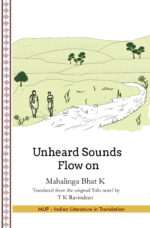
Unheard Sounds Flow On
₹315.00Author: K Mahalinga, Translator: T K Ravindran
In spite of being one of the oldest members of the Dravidian family of languages, Tulu, unfortunately, has not yet found the recognition that it richly deserves in the modern world. Since modernity privileges the written over the spoken, the Tulu language that is abundantly blessed with oral literature has been placed on the fringes of modern literary world. Ironically, Tulu is still engaged in a desperate fight for official status in a country that boasts of its cultural and linguistic diversity. The motives behind the translation of Nanajjer Sude Tirgayer, hailed as the first modern Tulu novel, into English refuse to remain apolitical in this context.
The novel, which has already been translated into Kannada, Konkani and Malayalam, beautifully captures the pulse of rusticity that characterizes the life of a village community that lived its life with its love-hate relationship with nature, more than 75 years ago in a Tulu speaking village in the south-western part of Karnataka. Besides bringing alive the socio-cultural practices that find their articulation through the natural linguistic plurality ingrained in the village psyche, the novel touches upon the duality of human nature that leaves man perennially condemned to an inner crisis.
Interested customers may write to us at mup@manipal.edu about purchasing the book.
Also available on
-
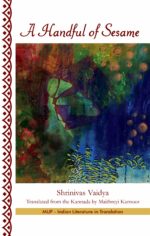
A Handful of Sesame
₹310.00Author: Srinivas B Vaidya, Translator: Maithreyi Karnoor
With a captivating start, A Handful of Sesame plunges us into the heart of the dying years of the 1857 mutiny. But the mutiny is largely a backdrop to the novel. When Kamalanabh of Kashi is manipulated by an impoverished Brahmin of Navalgund into marrying his daughter, the novel becomes basically the story of an internal migration. This is rare, and it remains one of the strengths of the novel. We are so used to speaking of migration across the postcolonial bridge and accredited national borders that we forget that India is a country of endless internal migrations – in the past and the present.
Interested readers may write to us at mup@manipal.edu about purchasing the book.
Also available on
Be the first to review “Akka Mahadevi, the questioning poet-saint”
You must be logged in to post a review.