
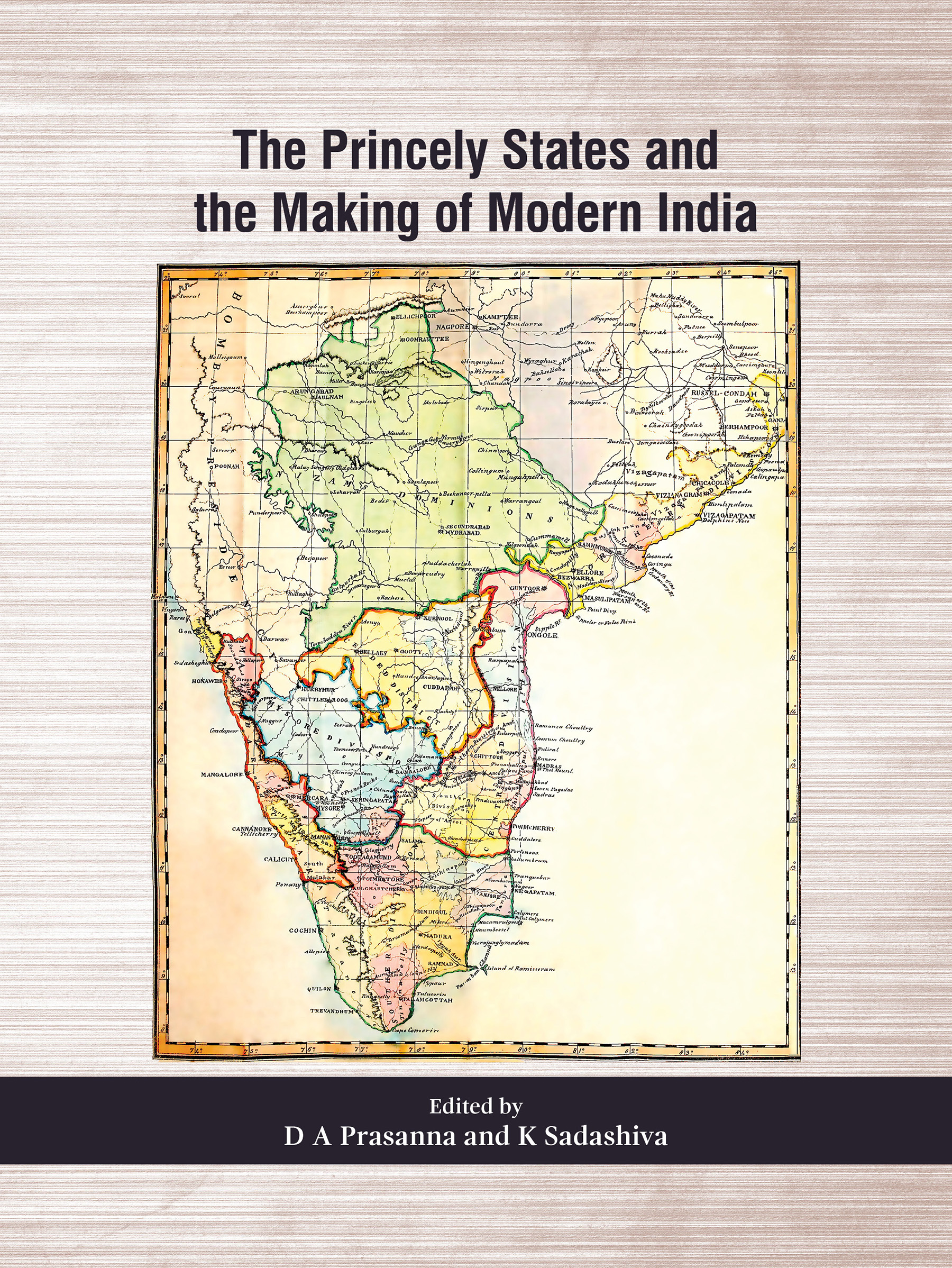
The Princely States and the Making of Modern India
₹640.00
Editors: D A Prasanna, K Sadashiva
India’s Princely States have enjoyed only a minor place in the narrative of modern nationhood. Certain Princely States used the dynamics of transfer of power to carve autonomy from the colonial British to advance their societies. Some of the Princely States modernized their education, public health and industrial sectors way ahead of the British administered territories. Prof Washbrook provides a macro picture of the dynamics in the Princely States of South India and sees a distinctive and indigenous form of modernity. Hierarchy, religion, heredity and caste were not obliterated for rationalism and secularism. As socialism and pseudo-secularism are fading away, the significance of the indigenous forms of modernity of the Princely States becomes more relevant to understand India in the 21st century. Ten historian thought leaders provide an interesting perspective to make it a compelling read. K Sadashiva is the architect of this book. As he developed the theme and brought together historians from various parts of the world, an interesting tapestry was woven. He is a historian actively researching the Indian Union, the Princely States and the rise of political power of caste and class in independent India. D A Prasanna has an interest in history, visual art, public health and education. He has supported new initiatives in these fields and has actively nurtured ideas to result in outcomes.
Interested readers may write to us at mup@manipal.edu about purchasing the book.

| Author | |
|---|---|
| Format |
Related products
-
Capturing the Cosmic Light – A Handbook of Astrophotography
₹670.00Author: Sathyakumar P M Sharma
The Handbook of Astrophotography is the first book dedicated to Astronomical Imaging through modest equipment, and the first to be published in India. It is a chronicle of the techniques learnt and employed by the author and is by no means proprietary. It is assumed that the reader is equipped with the basic knowledge to use a digital camera. After showing the many methods to capture the Cosmos, the book shows how to process these images. It is designed to be a handbook and not a user manual. The author hopes that the reader will be confident in astronomical imaging and develop his/her own techniques after reading the book. Sathyakumar started Astrophotography in January 2006 with a homemade wooden star-tracking mount and a camera borrowed from a friend. He later used his homemade Newtonian reflector telescope and an inexpensive digital camera to capture photos of the Moon. With an MSc in Aerospace engineering from the University of Salford, Manchester, he joined Opticstar Ltd, as a design engineer. There he was trained on the latest of astronomical instruments available for the amateur astrophotographer and eventually purchased the Celestron C8 Schmidt cassegrain telescope and the CG-5 Equatorial mount. Currently, he uses a GSO 6 inch RC telescope and an HEQ5-PRO computerized mount as well as an Orion 80ED Apochromatic telescope for astrophotography. He also owns an Astrotrac to take wide field vistas of the Cosmos. He is now employed as a Scientific Officer at Karnataka Science and Technology Promotion Society, Department of Science and Technology, Govt. of Karnataka.
Interested readers may write to us at mup@manipal.edu about purchasing the book.
Also available on
-
Culture and Creativity: Selected Writings of N Manu Chakravarthy
₹450.00Author: Manu Chakravarthy Editor: Unni Krishnan Karikkat
Culture and Creativity is a collection of essays of N Manu Chakravarthy, a prominent culture critic known for his discourses on music, cinema, literature and several aspects of culture and philosophy. This book illustrates the intellectual and ethical perspectives that shape his discussions on wide range of issues. These discussions are reflective of the inspiration he draws from his father Prof G N Chakravarthy and his teachers Prof C D Narasimhaiah, Prof U R Ananthamurthy, and Prof B Damodara Rao. The ideas of Ivan Illich and Noam Chomsky, and his friend D R Nagaraj are also instrumental in framing the critical nature of his interpretations. The essays in this book encompass Prof Manu Chakravarthy’s perspectives on religion, secularism, tradition, and modernity. The references to Sri Narayanaguru, M K Gandhi, Rabindranath Tagore, and the interview with Gustavo Esteva, evince his preoccupation with madhyamamarga. They also foreground his views on nationalism, metaphysics, media, politics and the crises of the third world and India in a globalised context. This work is a testimony to the form of scholarship he values.
Interested readers may write to us at mup@manipal.edu about purchasing the book.
Also available on
-
Geoffrey Bawa – A Conscious Perception
₹650.00This book is all about giving the readers a peek view into the life of Geoffrey Bawa; Sri Lanka’s most famous architect… a book that reveals an insight into his work through his most famous projects accompanied by beautiful hand drawn illustrations. Alluring and simply authentic, these self-narrative illustrations are a result of a personal experience. This book will give readers an understanding of how successfully Geoffrey Bawa had inculcated spaces, vistas and landscape with that of the built environment bringing about a touch of Modern Tropism and fusing it together with the rich culture and traditions of Sri Lanka.
Interested readers may write to us at mup@manipal.edu about purchasing the book.
Also available on
-
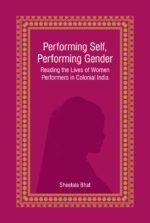
Performing Self, Performing Gender: Reading the lives of Women Performers in Colonial India
₹299.00Author: Sheetala Bhat
This book explores the shifting identity of the female performer in India, starting from the late 19th century to the early years of independence, through the study of autobiographies and memoirs. It attempts to make visible the actress figure by entering the history of performance, guided by the voice of the female performer. The discussion on performing woman in this book spans across the performing traditions of the tawaif, actresses in public theatre, early Indian film actresses, and actresses in the Indian People?s Theatre and the Prithvi Theatre. Sheetala Bhat is an actress and a writer from Sirsi, a small town in the Western Ghats of Karnataka. She holds an MA in English Literature from Manipal Centre for Philosophy and Humanities, Manipal University, Manipal. She worked with Chintana repertory, exploring the possibilities of theatre in education in government schools in Karnataka. She writes short stories and poetry in Kannada. Being a reclusive reader and an enthusiastic actress, she often finds herself rummaging and weaving in between the fields of theatre and Indian literature, with an emphasis on the gender concerns in these areas. Performing Self, Performing Gender: Reading the Lives of Women Performers in Colonial India is her first book.
Interested readers may write to us at mup@manipal.edu about purchasing the book.
Also available on
-

Pharmaceutical Consumer Complaints: A Guide to Academia and Pharmaceutical Industry
₹795.00Editors: Girish Pai Kulyadi, Muddukrishna B S, Richa Ajay Dayaramani
This book is an excellent guide in analyzing consumer complaints and will aid the students who are yet to gain industry experience. It is necessary for resolving consumer complaints in pharmaceutical industry where such concerns are frequently received. The case studies provide a vivid description of defects that will help identify the nature of the issue, possible root cause of such complaints, and subsequent remediation.
Interested readers may write to us at mup@manipal.edu about purchasing the book.
Also available on
-

Childhood Cancer
₹185.00Authors: H S Ballal, P D Gupta
Childhood Cancer is a major medical problem in most of the societies of the modern world. Though enough literature is available on the subject, it is not easily intelligible to common people. An ordinary parent whose ward is affected by any form of childhood cancer would beat a loss without the basic information. This book is aimed at educating a non-professional who wishes to grasp the problem in detail and in a simple way. The book primarily deals with the signs and symptoms of cancer in children which enable early detection. It is written in a lucid manner to remove the myth among parents that diagnosis of cancer in children amounts to a death sentence. Many of the childhood cancers, if detected early, can be cured completely, and the patients can live the rest of their lives like any other normal people. The book is an attempt to create this awareness among parents through proper information about the disease. Further, the book would also serve as a manual for MBBS students and professionals in other fields for primary treatment and management of the childhood cancer patients.
Interested customers may write to us at mup@manipal.edu about purchasing the book.
Also available on
-
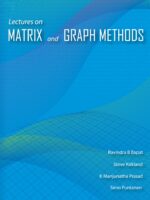
Lectures on Matrix and Graph Methods
₹580.00Lectures on Matrix and Graph Methods Lectures on Matrix and Graph Methods portrays selected lectures delivered by leading Mathematicians and Statisticians in the International Workshop on Combinatorial Matrix Theory and Generalized Inverses of Matrices organized by Department of Statistics, Manipal University, Manipal, India, during January 2-7, 2012. This book covers the topics even beyond the traditional applications of matrix theory and spectral theory of graphs. Graph Theoretic Applications to Computing the Nucleolus of an Assignment Game by T E S Raghavan and Introduction to Yantra Magic Squares and Agrippa-type Magic Matrices by G P H Styan et al. are among those topics. Also, an interview with S K Mitra in 1993 by G P H Styan and Simo Puntanen is presented here.
Ravindra B Bapat, Steve Kirkland, K Manjunatha Prasad, Simo Puntanen Ravindra B Bapat is at the Indian Statistical Institute, Delhi Centre. His main areas of interest are combinatorial matrix theory, matrices and graphs, and generalized inverses. He is a Fellow of the Indian Academy of Sciences, Indian National Science Academy and a J C Bose Fellow. He served as the President of the Indian Mathematical Society during 2007-2008. Steve Kirkland is a Stokes Professor at the National University of Ireland Maynooth. His research interests include non-negative matrix theory, spectral graph theory, and combinatorial matrix theory. He is currently the Editor-in-chief of the journal ?Linear and Multilinear Algebra?, and the President of the International Linear Algebra Society. K Manjunatha Prasad earned his PhD from Indian Statistical Institute. Currently, he is a Professor of Mathematics at Department of Statistics, Manipal University, Manipal. His research interests are matrix theory, generalized inverse, ring theory and projective modules. Simo Puntanen earned his PhD in statistics from the University of Tampere (Finland) in 1987, where he is presently a Lecturer.
Interested readers may write to us at mup@manipal.edu about purchasing the book.Also available on
-

A Concise Textbook of Drug Regulatory Affairs
₹290.00This book has 12 chapters covering nearly all the areas of Drug Regulatory Affairs. Various aspects of Drug Regulatory Affairs such as new drug approval procedure, pharmacovigilance, product recall, evolution of drug regulations in the United States of America (USA) and process of drug approval in the USA and European Union, bioequivalence regulations, electronic Common Technical Documents (eCTD), environmental regulations, orphan drugs pharmaceutical pricing and control policy, Pharmacovigilance system in India and the USA, Product Recall, regulations of pharmaceutical drug promotion and Pharmacy Practice regulations are covered in this book. As a whole, the book is a comprehensive reference book on regulatory affairs and will be very useful for the practicing professionals and students alike.
Interested readers may write to us at mup@manipal.edu about purchasing the book.
Also available on