
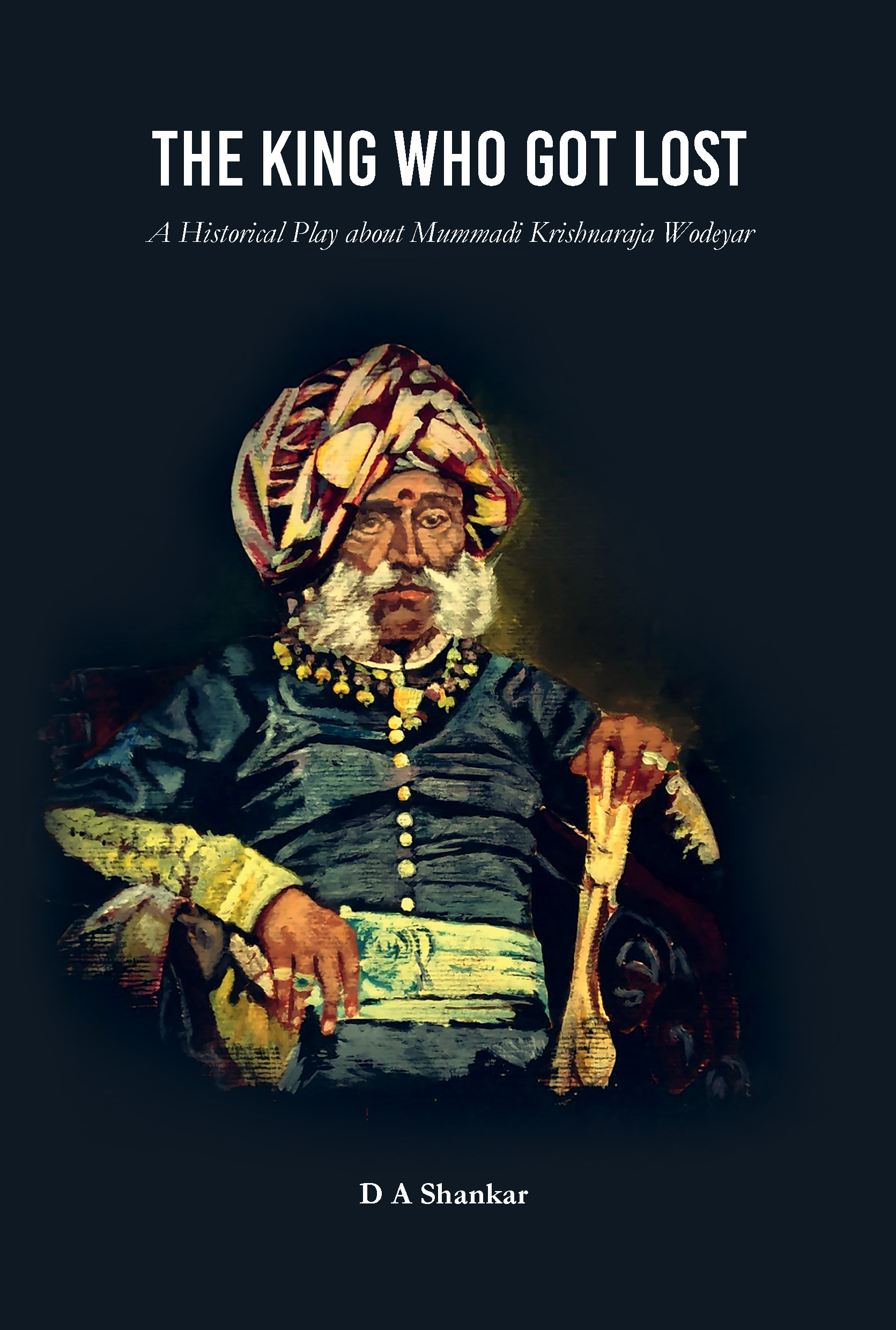
The King Who Got Lost: A Historical Play about Mummadi Krishnaraja Wodeyar
₹200.00
Young Mummadi, put on the throne by the British after the last Mysore war in 1799, was brought up under the watchful guidance of the far-sighted and shrewd Dowager Maharani Lakshmammanni. After falling into the hands of the powerful and politically experienced Dewan Purnaiah, he had a tortuous and tortured life. The young prince was never able to outgrow the influence of two of these mentors. To add to this, Mummadi, fell prey to an easy and rather voluptuous life. He was married but in addition to his many wedded consorts, he was caught in the spying and quarrelsome domestic life. Mummadi could never, despite valiant efforts, free himself and grow into a self-confident king.
The pressures of the ruthless British administration and the local, disruptive, and rebellious chieftains made Mummadi’s life a sad, tragic tale bordering on the ridiculous and the pathetic.
Interested overseas customers may write to us at mup@manipal.edu about purchasing the book.
Also available on

| Author | |
|---|---|
| Format |
Related products
-

A Birder’s Handbook to Manipal
₹655.00The third edition of A Birder’s Handbook to Manipal documents 260 species of birds observed in Manipal since 2009. It is more concise and informative than the previous editions, covers more species and has up-to-date maps and documentation notes. This edition also comes with a waterproof quick-ID guide for easy use in the field, as well as bird sounds. Ramit Singal is a former student of Manipal Institute of Technology. He founded the Manipal Birders’ Club and authored the first and second editions of this book. In the past, he has been associated with Centre for Wildlife Studies and Nature Conservation Foundation as well as a number of short-term projects across the country. He enjoys spreading the love for birds amongst others and has been working with bird-related citizen science projects over the past few years.
interested readers may write to us at mup@manipal.edu about purchasing the book.
Also available on
-
Just a few pages: Some Memories of Saraswatibai Rajwade
₹210.00Author: Vaidehi, Translator: Deepa Ganesh
This book is a coming together of two women writers of modern Kannada literature; one from its early period, the other, a contemporary. Saraswati Bai Rajwade, the early writer, became a fable, a mythology, leaving behind only the shadows of her writing. Vaidehi, the contemporary writer, reinvents Rajwade from the folds of history and gives her a life in the present. Saraswati Bai Rajwade was born into a poor family in the Dakshina Kannada of yore. By chance, she stepped into theatre and later into films. But all the glory that came to her unexpectedly, vanished just as suddenly. She later became the wife of a rich and high official, travelled abroad and underwent immense suffering. In her pain and loneliness, she took to books and also began to write and attained glory as a writer. In the last years of her life, she returned to a life of austerity and anonymity. Vaidehi has collected bits and pieces from her life and writing, presenting before us a unique tapestry. In this tapestry, Vaidehi?s perceptions criss-cross with Rajwade?s life and writing. Art does not reside in the object, but in its close encounter with life. This work unfolds before us as a grand illustration of such twin narratives.
Interested readers may write to us at mup@manipal.edu about purchasing the book.
Also available on
-
Comets – Nomads of the Solar System
₹290.00This book introduces the general reader to the world of comets – those celestial visitors from the outer Solar System that occasionally visit the Earth’s neighbourhood and put up spectacular shows in the night sky. The world had geared up for just such a show at the end of 2013, when Comet ISON was expected to light up the night sky. Using the occasion to bring the world of comets to those interested, this book is a delightful read about the quirky world of these unpredictable visitors. Apart from lucidly and accurately updating the reader about what comets are, where they come from, why is it that they assume the fantastic shapes they do etc. “Comets” also regales the reader with myths about comets in various cultural contexts, snippets about famous comets in the history of mankind, anecdotes on comet discoveries and discoverers, the bewildering procedures followed while naming comets and much more. The book takes a hard look at the hype surrounding the fiery expectations about Comet ISON an cautions the reader that, while there was a good chance of the comet blazing forth in the skies of December 2013, there was a realistic chance that the comet would not survive its close encounter with the Sun. Sadly, the pessimistic predictions came true and the comet disintegrated as it went around the Sun. As we wait for chance to throw us a Great Comet to gaze at in the future, “Comets: Nomads of the Solar System” is an excellent guide to prepare for the event!
Interested customers may write to us at mup@manipal.edu about purchasing the book.
Also available on
-
Ancient Stone Riddles: Megaliths of the Indian Subcontinent
₹185.00Ancient Stone Riddles is an introduction to the fascinating but less-known monuments called megaliths in the context of the Indian subcontinent. The book seeks to present the current understanding among archaeologists and other researchers in a lucid manner to the general reader, while stimulating thought on the many questions that linger about these remnants from our distant past and the people and cultures that built them. It also discusses recent research about the knowledge systems possessed by the megalith builders, including the possibility that some of these monuments were erected to observe celestial cycles.
Interested customers may write to us at mup@manipal.edu about purchasing the book.
Also available on
-

The Practice of Geopolitics
₹850.00Author: M D Nalapat
Intended to be a Practioner’s Guide to Geopolitics, the book provides a look into the thought processes that generate correct and timely analysis of global events. Geopolitics needs to weave within its analytical grasp economics, society, strategy and even culture, as the science deals with overall national capabilities as well as the mutal synergy and frictions between nations. Although a broad range of subjects has been covered in the book, each is anchored in the ground reality of events having a profound impact on the lives of citizens and on world events. The growing interconnectedness of the globe has resulted in a need to do away with the popular west centric models of international relations and to view events not through that single prism but from a holistic viewpoint that accepts the relevance and maturity of different histories and geographies. What the book provides is an alternative Weltanschauung to the dominant models of geopolitical analysis, so that the science is enabled to cross beyond the narrow boundaries which have confined. The scope and applicability of its analysis. The rise of Asia needs a geopolitical vision unique to the continent, and this is what has been provided by Professor Nalapat.
Interested readers may write to us at mup@manipal.edu about purchasing the book.
Also available on
-
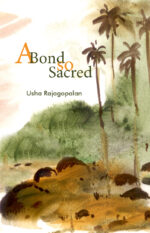
A Bond So Sacred
₹450.00A Bond So Sacred tells the story of Raman, a satyagrahi, who adopts Kokila, an orphan. He leaves the five year old in the care of his mother while he plunges into the freedom struggle. His nationalist fervour, however, clashes with his love for Amina, his charming neighbour who wants parental approval to their marriage. Raman’s mother is as staunch a Brahmin as Amina’s father is a Muslim. Will Raman be able to get their consent. The joy of India becoming an independent nation is marred by Gandhiji’s death. Raman’s fellow satyagrahis have gone their ways and he finds himself with no role to play in a rapidly changing country. Meanwhile, Kokila, his protégée, has her own battles to fight. As the years bring them together again, Kokila discovers truths about Raman that she would never have imagined. She is forced to confront the ghosts of the past, his and hers.
Interested readers may write to us at mup@manipal.edu about purchasing the book.
Also available on
-

Post Googlism and Other Short Stories
₹350.00Author: R C Natarajan
This collection of short stories is for the fast-paced millennials, whom the author calls “The Post Googlist Generation” who want everything hastily, at their finger-tips and on the go. The language has also shrunk in size to allow the pace. The world-view of this generation is that what cannot be done through an app cannot and should not be done. Their expectations of a story are a striking start, a quickly built middle and an interesting end. Stories in the collection seek to meet these expectations of this generation talking to them in their own language. They also echo the changing lives and changing aspirations of the time.
Interested readers may write to us at mup@manipal.edu about purchasing the book.
Also available on
-
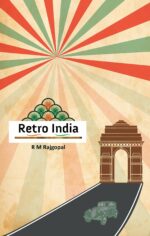
Retro India
₹350.00Author: R M Rajgopal
Retro India is, in essence, a trip down the memory lane, meandering through the sixties, seventies, eighties and nineties of the twentieth century. Today’s youth would battle with the fact that India had experienced a sweeping change from what it was in just as recently as thirty years ago. What kind of a moribund economy could engender a continuing state of shortages, high inflation, low growth, a paucity of jobs, rampant smuggling, and a foreign exchange situation that was perpetually perilous! It took major political and economical transformations to remove the shackles that then bound the economy. This narrative provides a clear bridge between the then and now for the younger generations. And for the older reader, it provides a heap of nostalgia. In the latter half of the twentieth century, the changes in India have been vast and comprehensive. In these decades, economic indicators such as India’s growth in GDP rate, the proliferation of the number of Airlines in the Indian skies, the multiplying of car models, the flourishing of telephone connections and moving on to the world of mobiles, televisions going colour from black and white to operating with over a thousand channels, India turning digital, and so on clearly directs that India had taken a crucial turn in its history. India has changed. And how! The Indian consumer grins. This is notwithstanding the fact that poverty is endemic and the gulf between the rich and the poor.
Interested readers may write to us at mup@manipal.edu about purchasing the book.
Also available on