
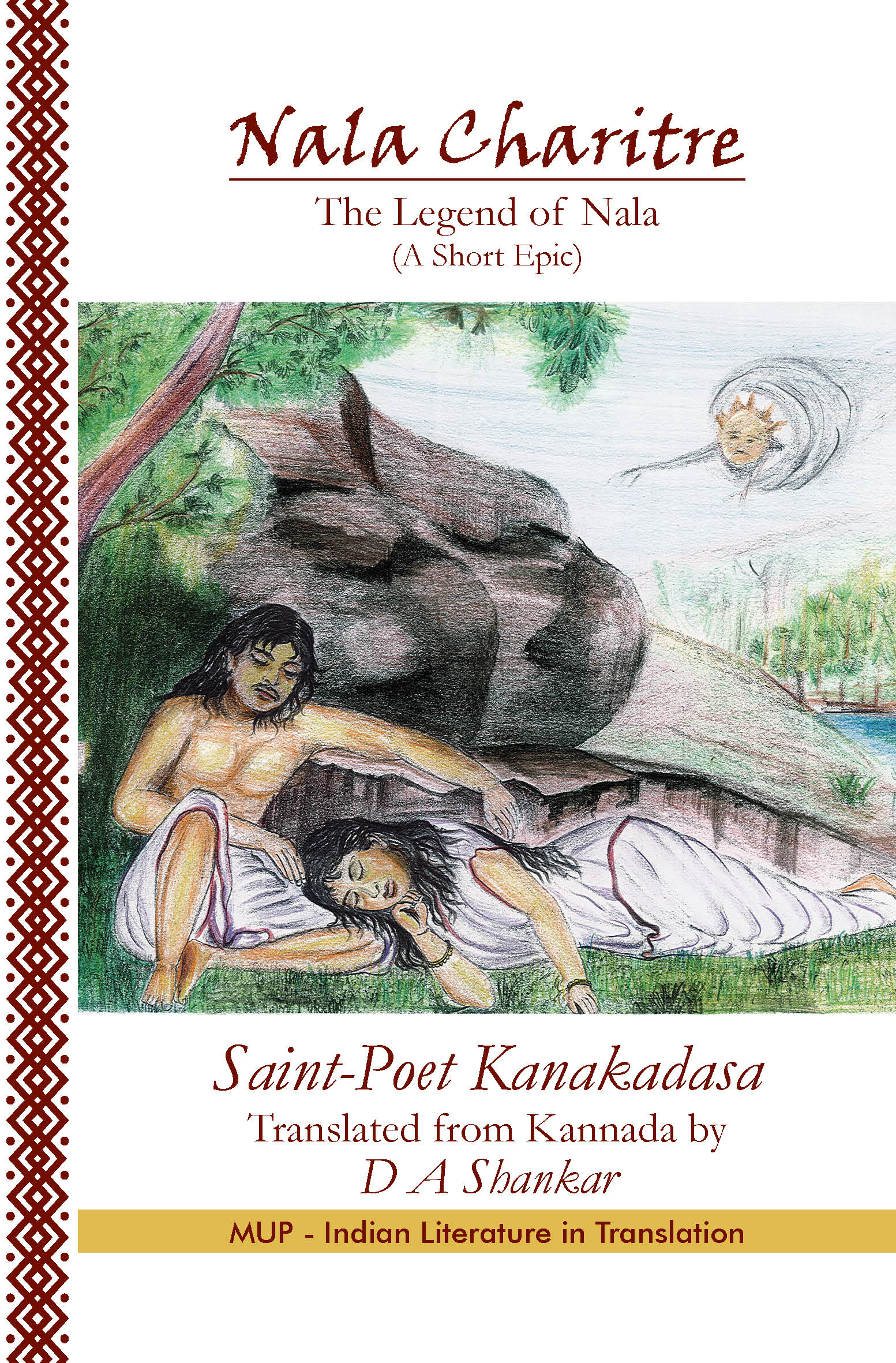
Nala Charitre: The Legend of Nala(A Short Epic)
₹295.00
This book presents the mythological narrative of Nala-Damayanti as an epic poem in English. Among the luminaries of sixteenth century Bhakti tradition, Kanakadasa’s literary and musical compositions (kirtanes) are imbued with philosophical meanings, which show immense formative influence on the cultural and literary scene of Karnataka. Also, Kanakadasa’s literary works such as Mohana Tarangini, Haribhaktisara, and the eminent allegorical masterpiece Ramadhanya Charitre incorporate metaphors taken from everyday life, which fascinate the commoners and offers them respite from mundane life-struggles. While such metaphorical expressions represent a remarkable trend in Bhakti poetry, in Kanakadasa?s depiction of Nala and Damayanti’s misfortunes, the toilsome life of common men and women stares forth. Hauled out of their palatial leisurely living, a curious turn of events compels them to survive amidst endless suffering. On one hand Nala Charitre is a poignant story of love, and on the other, it thematizes human existence, humandivine relationship and simplifies poetry to reach the audience beyond the limited circle of literates. As the Bhakti Literature assimilates the vernacular into devotional poetry, Kanakadasa?s epic poem interweaves mythological themes from Mahabharata with struggles of medieval Indian society, thus overcoming the binaries of human and divine.
Interested readers may write to us at mup@manipal.edu about purchasing the book.
Out of stock
| Format |
|---|
Customer Reviews
There are no reviews yet.
Related products
-

If we meet again we shall smile
₹199.00Author: Anushua Chakrabarti
People leave our lives. Some simply walk away from our world while some leave this world altogether. Through visuals, poetry and short stories, the author has a dialogue with the reader that takes them both through a journey full of characters that are no more, and yet have shaped the story. This fictional dialogue is a short trip down memory lane that visits the relationships one keeps hidden beneath.
Anushua Chakrabarti, originally from Kolkata, is a wandering minstrel. She lives on travel and music. Anushua has completed her MBA from TAPMI, Manipal, India, post which she worked in top technology brands like HP and Microsoft. She is presently back in Kolkata, driving social service through her acquired experience. Anushua has faced several childhood traumas but she believes she is what she is today, not in spite of it; but because of it.
Interested readers may write to us at mup@manipal.edu about purchasing the book.
Also available on

-
Pot of Butter and other short stories
₹250.00Author: Sunanda Belgaumkar Translator: Sa Usha, Vaijayanti Suryanarayana
Pot of Butter and other Short Stories is a collection of nine short stories, originally composed by Sunanda Belgaumkar in Kannada, handpicked and translated from her collections – Kajjaya and Koduvudenu Kombudenu. The bulk of her literary work including the stories in this book are inspired by the experiences in her early life, in the rustic and robust atmosphere of Dharwad. Her stories are predominantly semiautobiographical, laced with a liberal dose of artistic freedom.
This collection weaves together her writings on the underprivileged and marginalized as seen from the comfort of her palatial home, but rendered with compassion and empathy. Often, we find her narrative infused with self-directed questions such as, “What if I was in her shoes? ” or “Could that have been me? ” These stories are reflections on human nature, suffering, and destiny. There is hope, there is despair. There is love, there is longing. There is defeat, and there is triumph. In her stories, an oft-recurring metaphor for picking up one’s life after loss is a scorching summer followed by a torrential downpour and subsequently a plant springing to life.
As a translation, this book attempts to introduce Sunanda Belgaumkar’s literary and artistic creations to the non-Kannada reader, retaining as much of the indigenous elements of the original writings as possible. In doing so, it seeks to preserve the cultural climate of North Karnataka as it was around fifty years ago.
Interested readers may write to us at mup@manipal.edu about purchasing the book.
Also available on
-
Mahāmmāyi
₹195.00Author: Chandrasekhara Kambara, Translator: Kathyayini Kunjibettu
Mahāmmāyi is the story of the legend of Shatavithaayi – the Goddess of death, and her adopted son Sambhashiva. Out of affection for her son, Goddess Shatavithaayi blesses him with the “power of life”. The blessing was that death will evade the people who are treated by Sambashiva. But a certain condition set by Shatavithaayi forbade him from healing every ill man. The condition was that, if Shatavithaayi stood on the right side of the patient, Sambhashiva could treat that person and he would live; but, if she stood on the left side of the patient, he should not treat that person as his death was inevitable. Through a distinct method of story-telling, the story follows the life of Sambhashiva as he begins to question the ideas of fate and destiny. Thus, the conflict between fate and human efforts to change that fate is vividly described in this play.Interested readers may write to us at mup@manipal.edu about purchasing the book.
Also available on
-
Akka Mahadevi, the questioning poet-saint
₹255.00Author: D A Shankar
This book presents the mystical ruminations and literary excellence of Akka Mahadevi, the earliest example of a gender-liberated woman writer, credited with the composition of over four hundred and forty remarkably self-explorative Vachanas. Akka Mahadevi represents a powerfully authentic female voice of the radical, egalitarian Sharana Movement, which questioned the socially established barrier between genders and ushered in a world of socio-cultural equality.
In this book, the author explores the questioning spirit intrinsic to Akka Mahadevi’s life and writings, as she questions the widely held conventional norms: the traditional husband-wife relationship, her parents, elders; she questions Basavanna and Allama for their habituated patriarchal manner of speaking, and she bravely questions her personal deity whom she loves and adores. Apart from discerning a credible ‘history’ and background to Akka’s works, this book makes available a rendition of her selectively profound and memorable Vachana in modern English, that crosses the ?the gulf of language and the gulf of time.
Interested readers may write to us at mup@manipal.edu about purchasing the book.
Also available on
-
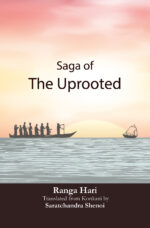
Saga of The Uprooted
₹95.00Author: Ranga Hari, Translator: Saratchandra Shenoi
This English translation of Visthapanachi Katha, a Konkani Khanda Kavya, depicts the saga of the migration of the Konkani community from Goa to a land far away from home. This collection of poems encapsulates the reign of a colonial power over the region of Goa that began with the entry of the Portuguese in the 16th century. It illustrates the displacement of the Konkani people and their resurgence at Cochin port. The poems describe the transformation of Goa – both culturally and topographically – and the people of Goa who were plundered, displaced, uprooted, and were forced to strip off their culture and identity. The poet is unfolding the tale of his very own ancestors by tracing out these events and graphically portraying the plight of the Konkani people. Saratchandra Shenoi, the author of this English translation, is a multilingual translator and a Sahitya Akademi Award winning (Antarnad – 1999) Konkani poet based in Kochi. He has over twenty books to his credit which include collections of poetry, works of fiction and non-fiction, translations, edited anthologies and language guides. Ranga Hari is the author of the Konkani original text titled Visthapanachi Katha. He has written more than twenty-five books in different languages, and was associated with Bharatiya Sikshan Mandal and Vidya Bharati.
Interested readers may write to us at mup@manipal.edu about purchasing the book.
Also available on
-
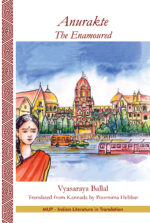
Anurakte- The Enamoured
₹390.00Author: Vyasaraya Ballal Translator: Poornima Hebbar
There are many rags-to-riches stories around the city of Mumbai. However, here is a story of transformation of a woman and her true self in the city of dreams. Set in Mangalore and Mumbai of the late 1940s, Anurakte- The Enamoured is an elegantly written story of a woman and her changing worldview over a period of time. Sumithra, a young woman with ordinary dreams and aspirations, comes to the then Bombay in search of livelihood. Little did she know that her experiences in the city and her zest for an independent life would transform her into a different person. She breaks the shell and resolves not to look back. The book is a poignant tale of love, loss, betrayal, family, relationships and traditions. The culturescape of Mumbai beautifully intertwines with her dreams. It is as much a story of the vibrancy of Mumbai as it is about Sumithra’s journey towards freedom.
Interested readers may write to us at mup@manipal.edu about purchasing the book.
Also available on
-
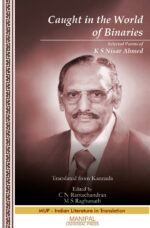
Caught in the World of Binaries: Selected Poems of K S Nisar Ahmed
₹310.00Author: K S Nisar Ahmed Editors: C N Ramachandran, M S Raghunath
Professor K S Nisar Ahmed (b 1936) is a geologist by profession and a major writer in Kannada. His first collection of poems, Manasu Gandhi Bazar (My Mind is like Gandhi Bazar) was published in 1960, and since then he has published poetry (15 collections), prose (five collections), and translations from Shakespeare and Neruda. He has been honoured with many awards, including ‘Padmashri’, Honorary D Litt (Kuvempu University), and Pampa Prashasti (Karnataka Government). Living between two languages and two cultures, Prof. Nisar has successfully achieved the balance necessary for the tight-rope walking as a poet. He believes that, “Only when you understand another religion (or culture or language), you really understand your own religion (or culture or language).” The present volume of 100 selected poems exhibits the multifaceted poetry of Nisar that reflects his creative pluralism. The 13 translators of the poems in this volume include A K Ramanujan, V K Gokak and Tejaswini Niranjana.
Interested readers may write to us at mup@manipal.edu about purchasing the book.
Also available on
-

Post Googlism and Other Short Stories
₹350.00Author: R C Natarajan
This collection of short stories is for the fast-paced millennials, whom the author calls “The Post Googlist Generation” who want everything hastily, at their finger-tips and on the go. The language has also shrunk in size to allow the pace. The world-view of this generation is that what cannot be done through an app cannot and should not be done. Their expectations of a story are a striking start, a quickly built middle and an interesting end. Stories in the collection seek to meet these expectations of this generation talking to them in their own language. They also echo the changing lives and changing aspirations of the time.
Interested readers may write to us at mup@manipal.edu about purchasing the book.
Also available on
Be the first to review “Nala Charitre: The Legend of Nala(A Short Epic)”
You must be logged in to post a review.