
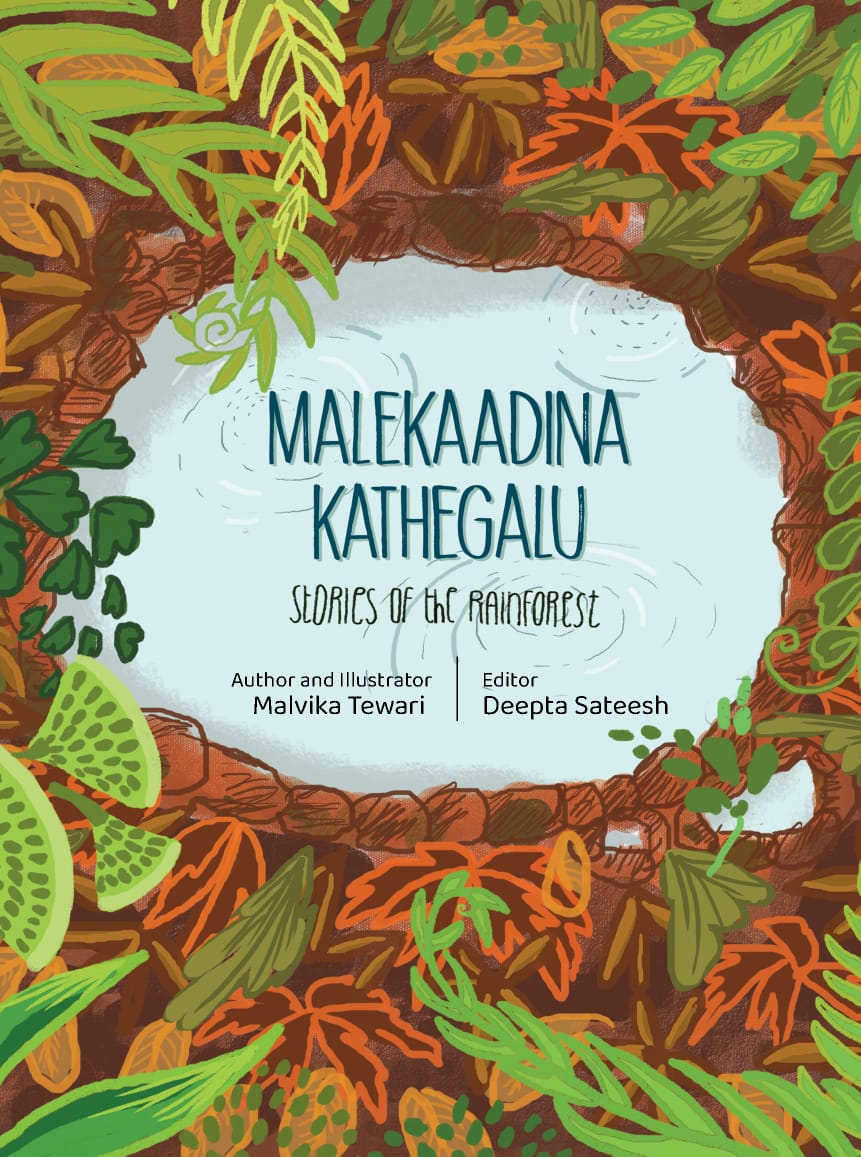
Malekaadina Kathegalu – Stories of the Rainforest
₹450.00
Author: Malvika Tewari, Editor: Deepta Sateesh
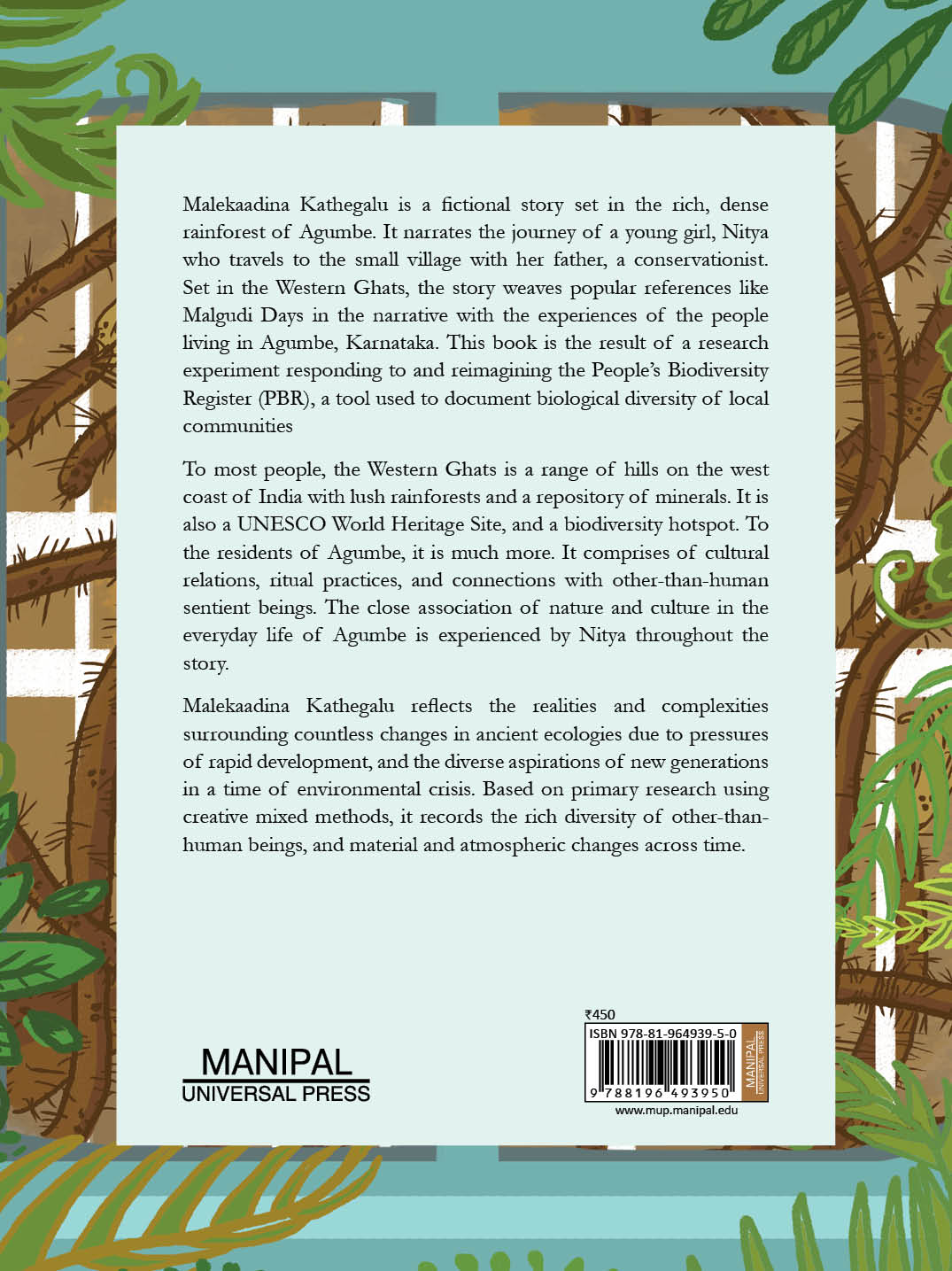
Malekaadina Kathegalu is a fictional story set in the rich dense rainforest of Agumbe, narrating the journey of Nitya, a young girl who travels to the small village with her father, a conservationist. This book is the result of a research experiment responding to and reimagining the People’s Biodiversity Register (PBR), a tool used to document biological diversity of local communities. Set in the Western Ghats, the story weaves popular references like Malgudi Days in the narrative with the experiences of the people living in Agumbe, Karnataka.
To most people, the Western Ghats is a range of hills on the west coast of India with lush forests in the monsoon and a repository of minerals. It is also a UNESCO World Heritage site and a biodiversity hotspot. To the residents of Agumbe, it is much more: cultural relations, ritual practices, and connections with other-than-human sentient beings. The nature-culture understandings, which comprise of everyday practices of food, kitchen gardens, and medicinal practices, and wandering on foot are experienced by Nitya throughout the story.
Malekaadina Kathegalu reflects the realities and complexities surrounding countless changes in ancient ecologies due to pressures of rapid development, and the diverse aspirations of new generations in a time of environmental crisis. It records the rich diversity of other-than-human beings and material and atmospheric changes across time through primary research using creative mixed methods.
Interested customers may write to us at mup@manipal.edu about purchasing the book.
Also available on

| Author | |
|---|---|
| Editor | |
| Format |
Related products
-
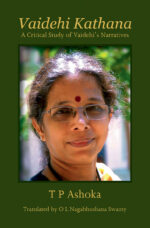
Vaidehi Kathana: A Critical Study of Vaidehi’s Narratives
₹250.00Author: T P Ashoka
Vaidehi Kathana is the first full-length literary critical study of the fictional, non fictional and poetic narratives of Vaidehi, who is considered to be one of the most celebrated contemporary Indian writers in Kannada. This work reviews, introduces, discusses and interprets all the writings of Vaidehi, which include short stories, poems, essays and a novel. The book examines how this great Indian writer has been reacting and responding to her time and space for the last four decades. The book shows how Vaidehi’s poetics has so subtly blended with her politics thereby creating some of the outstanding masterpieces in poetry and fiction of our times. The book discusses the special features of Vaidehi’s feminist perspectives as well as the uniqueness of her narrative skills. Arguing that Vaidehi’s spiritual triumph is demonstrated in her technical triumph, the book draws the attention of the non-Kannada readers to the entire body of Vaidehi’s writings. Lucidly translated into English by the noted translator O L Nagabhushana Swamy, T P Ashoka’s Vaidehi Kathana provides a meaningful opportunity for the non-Kannada readers to familiarize themselves with one of the greatest contemporary writers of India. T P Ashoka’s Vaidehi Kathana is a significant contribution to modern Indian literary criticism. The book provides an interesting reading not only to the students of literature, researchers and teachers but also appeals to the general readers.
Interested readers may write to us at mup@manipal.edu about purchasing the book.
Also available on
-
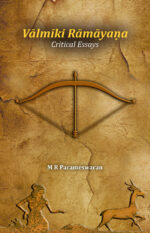
Valmiki Ramayana – Critical Essays
₹250.00Author: M R Parameswaran
This book critically engages with several important events and statements found in Valmiki’s epic poem, the Ramayana composed over 2500 years ago. Though certain methods were followed to preserve the Vedic texts, no serious methods were adopted to preserve the text of Ramayana. The poem spread to all parts of India and beyond through narrators of the epic who sometimes added their own explanatory verses to conform to local customs and traditions. In the second half of the 20th century, scholars at the Baroda Oriental Research Institute, after many years of labour and examination of over 2000 different manuscripts, compiled what is now accepted as the most reliable version of the poem. Based on this critical edition, a condensed English version by Dr Parameswaran was earlier published by the Manipal University Press. In the present book, Dr Parameswaran reviews the critical interpretations of scholars like Sheldon Pollock, R P Goldman and Wendy Doniger and has analytic responses to many unanswered questions. About the book: Dr M R Parameswaran has taught Mathematics as well as Sanskrit at the University of Manitoba in Winnipeg, Canada. His work Studies in Srivaishnavism, has been well received by academic scholars and Srivaishnavas.
Interested readers may write to us at mup@manipal.edu about purchasing the book.Also available on
-
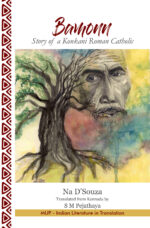
Bamonn: Story of a Konkani Roman Catholic
₹255.00Author: Na D’Souza Translator: S M Pejathaya
Konkani Roman Catholic Christians were converted from other groups by Goan Missionaries long back, keeping the caste system tradition to a large extent in layers such as the Bamonn, the Charodi, the Gawdi, the Nendar, the Shudra, etc. At the time of marriages and other social gatherings they continue to consider caste system norms and customs in the community. Caste system in Indian Christians is vividly described in the novel Bamonn. Christopher Pai of Kalyanpura hails from a Bamonn family and takes great pride in his ancestry. He believes in the stories about his Konkani Roman Catholic ancestors from his elders and about their being true Christians, holding on to their faith despite tremendous pressure to convert to Islam during Tipu Sultan’s regime. He also believes Bamonns are superior to other Christians in the community. After retiring from his job of a Headmaster, he refuels his obsession to retrace his roots and find out the truth about his ancestors. In his journey of self-assurance and faith, will he succeed in his mission to convince his family, his children and the community at large of his glorious ancestry and in still pride in the next generation? . . .
Interested readers may write to us at mup@manipal.edu about purchasing the book.
Also available on
-
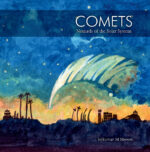
Comets – Nomads of the Solar System
₹290.00This book introduces the general reader to the world of comets – those celestial visitors from the outer Solar System that occasionally visit the Earth’s neighbourhood and put up spectacular shows in the night sky. The world had geared up for just such a show at the end of 2013, when Comet ISON was expected to light up the night sky. Using the occasion to bring the world of comets to those interested, this book is a delightful read about the quirky world of these unpredictable visitors. Apart from lucidly and accurately updating the reader about what comets are, where they come from, why is it that they assume the fantastic shapes they do etc. “Comets” also regales the reader with myths about comets in various cultural contexts, snippets about famous comets in the history of mankind, anecdotes on comet discoveries and discoverers, the bewildering procedures followed while naming comets and much more. The book takes a hard look at the hype surrounding the fiery expectations about Comet ISON an cautions the reader that, while there was a good chance of the comet blazing forth in the skies of December 2013, there was a realistic chance that the comet would not survive its close encounter with the Sun. Sadly, the pessimistic predictions came true and the comet disintegrated as it went around the Sun. As we wait for chance to throw us a Great Comet to gaze at in the future, “Comets: Nomads of the Solar System” is an excellent guide to prepare for the event!
Interested customers may write to us at mup@manipal.edu about purchasing the book.
Also available on
-
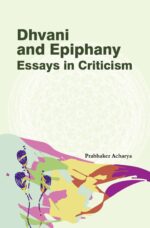
Dhvani and Epiphany: Essays in Criticism
₹270.00Author: Prabhaker Acharya
Dhvani and Epiphany examines the work of major Indian poets like Nissim Ezekiel and Arun Kolatkar; the struggle of young poets to find an audience; and the art of fiction. But its main focus is on the nature of creativity. How does an artist communicate his meaning? What makes a work genuinely creative? Through a sensitive exploration of poetry- ranging from the simple poems of a child, Poorna Prajna, to the complex “Byzantium Poems” of Yeats- the first seven essays try to show how a poem comes to life when it speaks to us and we listen to its dhvani and respond.
Even in fiction, it is not all realism. There is irony in exploring the paradoxical nature of reality; events taking on symbolic overtones; and epiphany, moments of illumination and insights – when surprising correspondences are seen. Writers cannot surprise and delight their audience if they themselves are not surprised and delighted by such insights.
Interested readers may write to us at mup@manipal.edu about purchasing the book.
Also available on
-
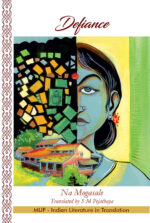
Defiance
₹495.00Defiance is a captivating tale of the march of globalization and its impact on the lives and times of the Santher Guthu family in Ombathkere, a village located between Mangaluru and Kasaragodu. Set in the picturesque Malabar coast of Karnataka in the late 20th Century, the novel takes the reader through four generations of the family. Ambakke, the protagonist, along with her brother Sankappa Hegde, the third-generation descendants of the family form the lifeblood of this story of human relationships in the midst of time and change. The novel is born out of deep contemplation of a community in the face of transition. There is anxiety that grips this part of Karnataka in the wake of modernity. The vast canvas of the novel and the depiction of folk culture provides a unique touch to the saga of the community. Defiance is a novel about traditions and the fear of losing out to modernity. It is about change and the desire to remain rooted.
Interested readers may write to us at mup@manipal.edu about purchasing the book.
Also available on
-
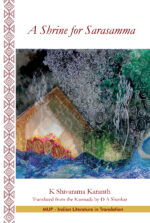
A Shrine for Sarasamma
₹180.00Author: Shivarama Karanth Translator: D A Shankar
A Shrine for Sarasamma is the English translation of Sarasammana Samadhi written by K Shivarama Karanth in 1937, in his early thirties. It offers one of the most authentic and searing accounts of Indian womanhood, which consistently, and through the ages, has suffered deep anguish, humiliation and crushing insult from the oppressive patriarchal culture prevalent in all parts of India and among all castes and classes. The novel is a classic in Kannada and the English translation is an attempt to bring to the English reading audience a taste of the regional classic.
Interested readers may write to us at mup@manipal.edu about purchasing the book.
Also available on
-
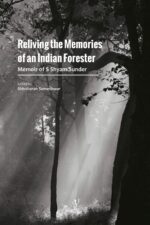
Reliving the memories of an Indian forester: Memoir of S Shyam Sunder
₹450.00Editor: Shiv Someshwar
Shyam Sunder’s memoir is a series of vignettes, from numerous comedic to a tragic few. The life narrated is varied and never short of excitement – being ten yards from a charging tusker or a foot away from a King Cobra; defying orders of the chief minister; being hauled up for contempt of the high court, and discussing with Indira Gandhi the best way to eat avocados. Possessed of wit and passion, the narration lays bare the hubris of popular discourse on noble forest livelihoods, and unflinchingly narrates neglect of rural communities, as well as of forests, at times by the callous imposition of rules and regulations.
Interested readers may write to us at mup@manipal.edu about purchasing the book.
Also available on