
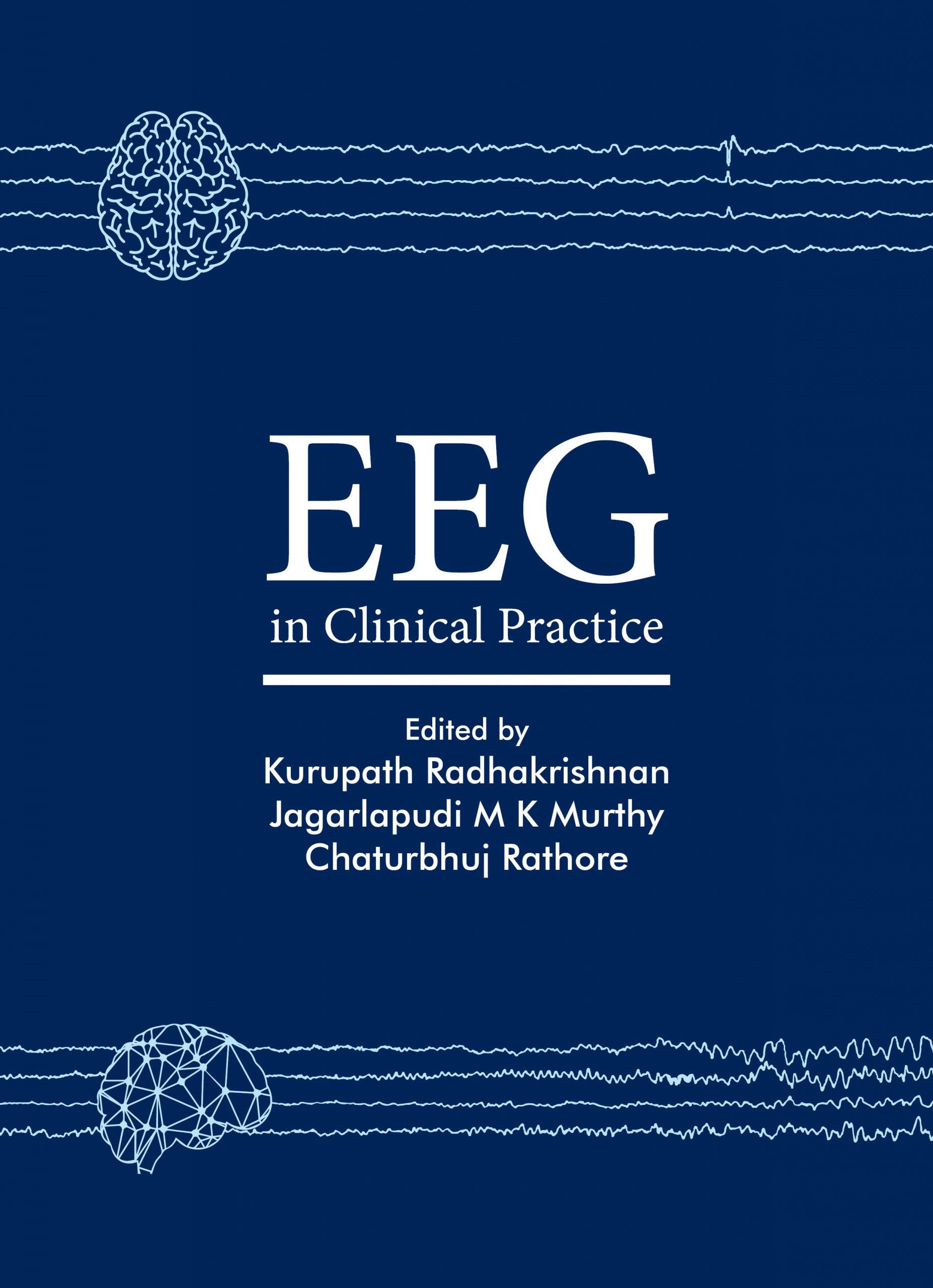
EEG in Clinical Practice
₹2,500.00
Editors: K Radhakrishnan, Jagarlapudi M K Murthy, Chaturbhuj Rathore
EEG in Clinical Practice is a comprehensive, easy-to-read, and well-illustrated book on scalp EEG. Through the text in its 21 chapters, 553 figures, and 94 tables describes practically every aspect of the scalp EEG including pathophysiology, technical challenges, and its value and limitations in the diagnosis of epilepsy and related disorders. Some of the recent advances such as EEG monitoring in intensive care units, quantitative EEG, and high frequency oscillations are also covered. Adhering to the systematic approach to reading and interpretation of the EEG, depicted in the final chapter, may help to minimize misreading of EEG and its consequences, which is highly prevalent especially in the developing countries. Though it is targeted at neurology trainees, young practicing neurologists, and neurotechnologists, it also serves as a reference guide for all the neurologists and electrophysiologists.
Interested readers may write to us at mup@manipal.edu about purchasing the book.

| Author | |
|---|---|
| Format |
Customer Reviews
There are no reviews yet.
Related products
-

Transformation Beyond Sight
₹395.00Author: Jibu Thomas
Transformation Beyond Sight is a gripping narrative of the author’s experience in the hospital administration of Kasturba Hospital (KH), Manipal. As an experiential account, the present book provides insights into the thoughts, concerns, and apprehensions of prospective hospital administrators, and spotlights the vital role played by a hospital administrator in the day-to-day operations of KH, which is also an advanced healthcare facility.This book draws attention to the transformational quality of the author’s experiences to emphasize that the evolution in leadership and management of the teaching hospital went hand-in-hand with the transformation of the author’s administrative skills, and his own persona as a diligent administrator. The biographical undertone also provides an insight into the complex and dynamic healthcare environment, alongside the competencies, creativity, and mindfulness necessary for an administrator. This book narrates a hospital administrator’s engagements with the traditional processes and his attempts to bring about effective changes in the management and monitoring of operations of KH and the overall management of a healthcare facility.
Interested readers may write to us at mup@manipal.edu about purchasing the book.
Also available on
-

Manipal Manual of Ear Mould Making
₹195.00Authors: Venkataraja Aithal U, Rekha Patil and B Rajashekhar
Manipal Manual of Ear Mould Making is a comprehensive workbook of value to students of Audiology & hearing professionals who wish to understand the nuances of this skill that is paramount for optimization of hearing aid fitting. This is a compilation of the authors? years of experience in the deft skills of ear mould making and patient care in Manipal Ear Mould lab. Considerable efforts have gone in to bringing out this manual by incorporating appropriate pictures, stepwise procedures and simple instructions. This manual, besides appraising the readers of the procedure would also assist them in learning the dos and donts picked up out of the authors? clinical experience. This will be a reflection of our ongoing efforts to derive the best out of the rapidly developing technology in the area of hearing impairment.
Interested readers may write to us at mup@manipal.edu about purchasing the book.
Also available on
-

Pharmaceutical Consumer Complaints: A Guide to Academia and Pharmaceutical Industry
₹795.00Editors: Girish Pai Kulyadi, Muddukrishna B S, Richa Ajay Dayaramani
This book is an excellent guide in analyzing consumer complaints and will aid the students who are yet to gain industry experience. It is necessary for resolving consumer complaints in pharmaceutical industry where such concerns are frequently received. The case studies provide a vivid description of defects that will help identify the nature of the issue, possible root cause of such complaints, and subsequent remediation.
Interested readers may write to us at mup@manipal.edu about purchasing the book.
Also available on
-

Internationalization of Higher Education: The Dynamics of Educational Ecology
₹500.00Editors: H Vinod Bhat, Neeta InamdarThe mobility of scholars seeking knowledge has been a part of the university ideal for centuries. History holds testimony to the fact that these mobilities have also altered the lives of people in different regions. Universities have played a pivotal role in the movement of people across borders and the resultant transformation of societies due to transcultural interactions.In this book, the editors have brought together ideas on the changing dynamics of these mobilities of scholars and the interconnectedness of higher education institutions in today’s world. An attempt is also made to record the implications of these international collaborations in knowledge generation and dissemination within the educational ecology. The notion of educational ecology is explored through the articles in the book to comprehend the power play that exists in the dimension and the direction of internationalization of higher education. All this is done with the hope that the opening up of education to global opportunities may, over a period of time, lead to equitable distribution of opportunities worldwide.Interested readers may write to us at mup@manipal.edu about purchasing the book.
International Edition available on 
South Asia Edition available on -
Lectures on Matrix and Graph Methods
₹580.00Lectures on Matrix and Graph Methods Lectures on Matrix and Graph Methods portrays selected lectures delivered by leading Mathematicians and Statisticians in the International Workshop on Combinatorial Matrix Theory and Generalized Inverses of Matrices organized by Department of Statistics, Manipal University, Manipal, India, during January 2-7, 2012. This book covers the topics even beyond the traditional applications of matrix theory and spectral theory of graphs. Graph Theoretic Applications to Computing the Nucleolus of an Assignment Game by T E S Raghavan and Introduction to Yantra Magic Squares and Agrippa-type Magic Matrices by G P H Styan et al. are among those topics. Also, an interview with S K Mitra in 1993 by G P H Styan and Simo Puntanen is presented here.
Ravindra B Bapat, Steve Kirkland, K Manjunatha Prasad, Simo Puntanen Ravindra B Bapat is at the Indian Statistical Institute, Delhi Centre. His main areas of interest are combinatorial matrix theory, matrices and graphs, and generalized inverses. He is a Fellow of the Indian Academy of Sciences, Indian National Science Academy and a J C Bose Fellow. He served as the President of the Indian Mathematical Society during 2007-2008. Steve Kirkland is a Stokes Professor at the National University of Ireland Maynooth. His research interests include non-negative matrix theory, spectral graph theory, and combinatorial matrix theory. He is currently the Editor-in-chief of the journal ?Linear and Multilinear Algebra?, and the President of the International Linear Algebra Society. K Manjunatha Prasad earned his PhD from Indian Statistical Institute. Currently, he is a Professor of Mathematics at Department of Statistics, Manipal University, Manipal. His research interests are matrix theory, generalized inverse, ring theory and projective modules. Simo Puntanen earned his PhD in statistics from the University of Tampere (Finland) in 1987, where he is presently a Lecturer.
Interested readers may write to us at mup@manipal.edu about purchasing the book.Also available on
-

Performing Self, Performing Gender: Reading the lives of Women Performers in Colonial India
₹299.00Author: Sheetala Bhat
This book explores the shifting identity of the female performer in India, starting from the late 19th century to the early years of independence, through the study of autobiographies and memoirs. It attempts to make visible the actress figure by entering the history of performance, guided by the voice of the female performer. The discussion on performing woman in this book spans across the performing traditions of the tawaif, actresses in public theatre, early Indian film actresses, and actresses in the Indian People?s Theatre and the Prithvi Theatre. Sheetala Bhat is an actress and a writer from Sirsi, a small town in the Western Ghats of Karnataka. She holds an MA in English Literature from Manipal Centre for Philosophy and Humanities, Manipal University, Manipal. She worked with Chintana repertory, exploring the possibilities of theatre in education in government schools in Karnataka. She writes short stories and poetry in Kannada. Being a reclusive reader and an enthusiastic actress, she often finds herself rummaging and weaving in between the fields of theatre and Indian literature, with an emphasis on the gender concerns in these areas. Performing Self, Performing Gender: Reading the Lives of Women Performers in Colonial India is her first book.
Interested readers may write to us at mup@manipal.edu about purchasing the book.
Also available on
-
Linear Algebra with Applications
₹650.00Linear Algebra with Applications portrays selected articles published earlier by Prof Ravindra B Bapat in various reputed journals. This volume published in honour of Prof Bapat, on the occasion of his 60th birthday, consists of his original research articles written in the area of (i) Permanent, Determinant and their applications, (ii) Non-negative Matrices, (iii) Matrix Methods in Statistics and Graph theory, and (iv) Generalized Inverses of a Matrix. Starting with an article A Generalization of a Theorem of Ky Fan on Simplicial Maps, his first article published in 1980, several articles probing the properties of permanent and determinant, characterization of generalized inverses, spectral properties of graphs, and applications of matrix methods in statistics are compiled in this volume. The articles selected in this book will certainly inspire the young linear algebraists and provide several matrix techniques to solve different problems in the area of applied linear algebra.
Interested readers may write to us at mup@manipal.edu about purchasing the book.
Also available on
-

The Practice of Geopolitics
₹850.00Author: M D Nalapat
Intended to be a Practioner’s Guide to Geopolitics, the book provides a look into the thought processes that generate correct and timely analysis of global events. Geopolitics needs to weave within its analytical grasp economics, society, strategy and even culture, as the science deals with overall national capabilities as well as the mutal synergy and frictions between nations. Although a broad range of subjects has been covered in the book, each is anchored in the ground reality of events having a profound impact on the lives of citizens and on world events. The growing interconnectedness of the globe has resulted in a need to do away with the popular west centric models of international relations and to view events not through that single prism but from a holistic viewpoint that accepts the relevance and maturity of different histories and geographies. What the book provides is an alternative Weltanschauung to the dominant models of geopolitical analysis, so that the science is enabled to cross beyond the narrow boundaries which have confined. The scope and applicability of its analysis. The rise of Asia needs a geopolitical vision unique to the continent, and this is what has been provided by Professor Nalapat.
Interested readers may write to us at mup@manipal.edu about purchasing the book.
Also available on
Be the first to review “EEG in Clinical Practice”
You must be logged in to post a review.