
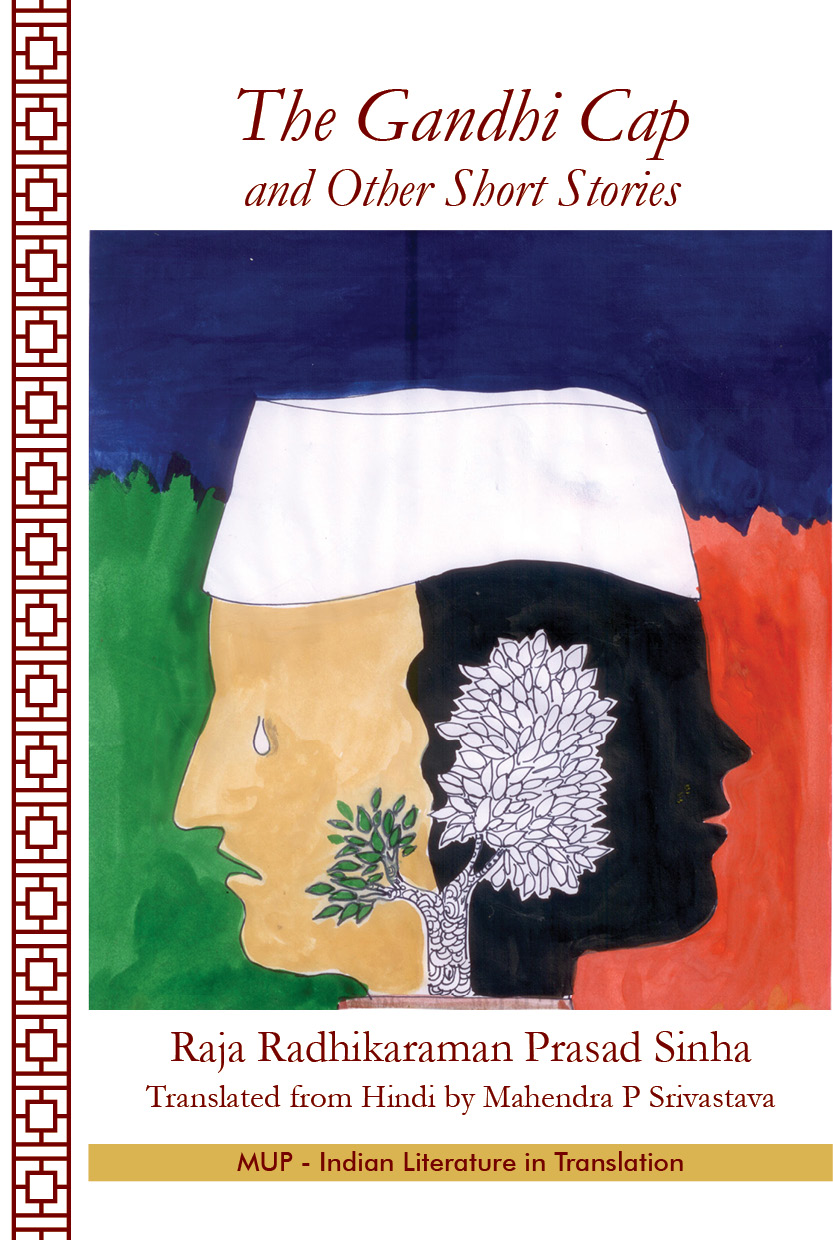
The Gandhi Cap and Other Short Stories
₹345.00
Author: Raja Radhikaraman Prasad Sinha, Translator: Mahendra P Srivastava
The book The Gandhi Cap and Other Short Stories offers a glimpse into the lifetime of work of a forgotten pioneer of Hindi fiction, Raja Radhikaraman Prasad Sinha. It is ironic that one cannot find a single book by this author who was so dedicated to Hindi literature. The stories in this collection are a testament not only to the contributions of Sinha to Hindi fiction but also, reflect the depth of political and social milieu of the times. Many readers will be moved by the elements patriotism, feminism, secularism, and spiritualism in these stories. Strong female characters are common in most of these stories. These characters provide both a moral fulcrum to the stories as well as reflect the struggle of women to balance prevailing customs with modernity. Some of these stories provide sharp political and social commentary that still have currency (The Gandhi Cap). Sinha incorporates a unique style of writing that uses lyrical prose and poetry together. He even employs a dialogue between the storyteller and a social gathering in the form of an epilogue, to offer a discourse on social dilemma about women’s plight to become modern while admonishing them to retain their Indian essence (An Expensive Bargain). We hope the readers will enjoy this wonderful collection.
Interested readers may write to us at mup@manipal.edu about purchasing the book.

Related products
-
Valmiki Ramayana – Critical Essays
₹250.00Author: M R Parameswaran
This book critically engages with several important events and statements found in Valmiki’s epic poem, the Ramayana composed over 2500 years ago. Though certain methods were followed to preserve the Vedic texts, no serious methods were adopted to preserve the text of Ramayana. The poem spread to all parts of India and beyond through narrators of the epic who sometimes added their own explanatory verses to conform to local customs and traditions. In the second half of the 20th century, scholars at the Baroda Oriental Research Institute, after many years of labour and examination of over 2000 different manuscripts, compiled what is now accepted as the most reliable version of the poem. Based on this critical edition, a condensed English version by Dr Parameswaran was earlier published by the Manipal University Press. In the present book, Dr Parameswaran reviews the critical interpretations of scholars like Sheldon Pollock, R P Goldman and Wendy Doniger and has analytic responses to many unanswered questions. About the book: Dr M R Parameswaran has taught Mathematics as well as Sanskrit at the University of Manitoba in Winnipeg, Canada. His work Studies in Srivaishnavism, has been well received by academic scholars and Srivaishnavas.
Interested readers may write to us at mup@manipal.edu about purchasing the book.Also available on
-
Pot of Butter and other short stories
₹250.00Author: Sunanda Belgaumkar Translator: Sa Usha, Vaijayanti Suryanarayana
Pot of Butter and other Short Stories is a collection of nine short stories, originally composed by Sunanda Belgaumkar in Kannada, handpicked and translated from her collections – Kajjaya and Koduvudenu Kombudenu. The bulk of her literary work including the stories in this book are inspired by the experiences in her early life, in the rustic and robust atmosphere of Dharwad. Her stories are predominantly semiautobiographical, laced with a liberal dose of artistic freedom.
This collection weaves together her writings on the underprivileged and marginalized as seen from the comfort of her palatial home, but rendered with compassion and empathy. Often, we find her narrative infused with self-directed questions such as, “What if I was in her shoes? ” or “Could that have been me? ” These stories are reflections on human nature, suffering, and destiny. There is hope, there is despair. There is love, there is longing. There is defeat, and there is triumph. In her stories, an oft-recurring metaphor for picking up one’s life after loss is a scorching summer followed by a torrential downpour and subsequently a plant springing to life.
As a translation, this book attempts to introduce Sunanda Belgaumkar’s literary and artistic creations to the non-Kannada reader, retaining as much of the indigenous elements of the original writings as possible. In doing so, it seeks to preserve the cultural climate of North Karnataka as it was around fifty years ago.
Interested readers may write to us at mup@manipal.edu about purchasing the book.
Also available on
-
A Shrine for Sarasamma
₹180.00Author: Shivarama Karanth Translator: D A Shankar
A Shrine for Sarasamma is the English translation of Sarasammana Samadhi written by K Shivarama Karanth in 1937, in his early thirties. It offers one of the most authentic and searing accounts of Indian womanhood, which consistently, and through the ages, has suffered deep anguish, humiliation and crushing insult from the oppressive patriarchal culture prevalent in all parts of India and among all castes and classes. The novel is a classic in Kannada and the English translation is an attempt to bring to the English reading audience a taste of the regional classic.
Interested readers may write to us at mup@manipal.edu about purchasing the book.
Also available on
-
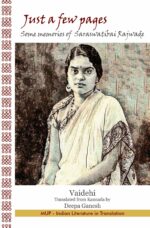
Just a few pages: Some Memories of Saraswatibai Rajwade
₹210.00Author: Vaidehi, Translator: Deepa Ganesh
This book is a coming together of two women writers of modern Kannada literature; one from its early period, the other, a contemporary. Saraswati Bai Rajwade, the early writer, became a fable, a mythology, leaving behind only the shadows of her writing. Vaidehi, the contemporary writer, reinvents Rajwade from the folds of history and gives her a life in the present. Saraswati Bai Rajwade was born into a poor family in the Dakshina Kannada of yore. By chance, she stepped into theatre and later into films. But all the glory that came to her unexpectedly, vanished just as suddenly. She later became the wife of a rich and high official, travelled abroad and underwent immense suffering. In her pain and loneliness, she took to books and also began to write and attained glory as a writer. In the last years of her life, she returned to a life of austerity and anonymity. Vaidehi has collected bits and pieces from her life and writing, presenting before us a unique tapestry. In this tapestry, Vaidehi?s perceptions criss-cross with Rajwade?s life and writing. Art does not reside in the object, but in its close encounter with life. This work unfolds before us as a grand illustration of such twin narratives.
Interested readers may write to us at mup@manipal.edu about purchasing the book.
Also available on
-
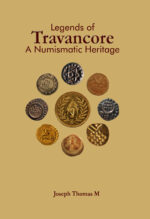
Legends of Travancore – A Numismatic Heritage
₹1,250.00The Kingdom of Travancore in the Southern part of India was a native state in British India which was well known for its progressive outlook. Its enlightened royalty ruled the country as Sree Padmanabha Dasa. They had in place a well oiled administrative mechanism that implemented various programs and reforms, resulting in an overall development of Travancore. Though Travancore was under the colonial rulers, there was a well-orchestrated administrative machinery for coinage. Coins were minted as per the specifications ordered by the periodically issued Royal Proclamations. It is creditable that Travancore retained its independence in its functioning to a large extent. This book is an insight into the coins of Modern Travancore (from 1729 AD) which not only reflects the religious beliefs of the rulers, but also sketches the socio-political atmosphere of the period. Dr Joseph Thomas hailing from Thiruvananthapuram, is a Professor of Urology at Manipal University in India. His passion for collecting coins developed into a serious numismatic pursuit. His special area of interest is the study of the history of Venad and Travancore. His detailed study of the Travancore coins and the various related issues give an insight into the rich numismatic heritage of modern Travancore. He is a Life Member of the Philatelic and Numismatic Association of Thiruvananthapuram and a Life Member of the South Indian Numismatic Society, Chennai.
Interested readers may write to us at mup@manipal.edu about purchasing the book.
Also available on
-

Colours of the Rainbow
₹450.00Author: Umesh Bhat
The author, through Colours of the Rainbow, tells us that everyone is destined for his/her own rainbow with a pot of gold at the other end if, one has a will, works hard on it, and with a little bit of luck. The book narrates the dream journey of a village boy.
Interested readers may write to us at mup@manipal.edu about purchasing the book.
Also available on
-
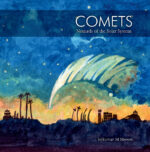
Comets – Nomads of the Solar System
₹290.00This book introduces the general reader to the world of comets – those celestial visitors from the outer Solar System that occasionally visit the Earth’s neighbourhood and put up spectacular shows in the night sky. The world had geared up for just such a show at the end of 2013, when Comet ISON was expected to light up the night sky. Using the occasion to bring the world of comets to those interested, this book is a delightful read about the quirky world of these unpredictable visitors. Apart from lucidly and accurately updating the reader about what comets are, where they come from, why is it that they assume the fantastic shapes they do etc. “Comets” also regales the reader with myths about comets in various cultural contexts, snippets about famous comets in the history of mankind, anecdotes on comet discoveries and discoverers, the bewildering procedures followed while naming comets and much more. The book takes a hard look at the hype surrounding the fiery expectations about Comet ISON an cautions the reader that, while there was a good chance of the comet blazing forth in the skies of December 2013, there was a realistic chance that the comet would not survive its close encounter with the Sun. Sadly, the pessimistic predictions came true and the comet disintegrated as it went around the Sun. As we wait for chance to throw us a Great Comet to gaze at in the future, “Comets: Nomads of the Solar System” is an excellent guide to prepare for the event!
Interested customers may write to us at mup@manipal.edu about purchasing the book.
Also available on
-
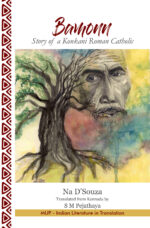
Bamonn: Story of a Konkani Roman Catholic
₹255.00Author: Na D’Souza Translator: S M Pejathaya
Konkani Roman Catholic Christians were converted from other groups by Goan Missionaries long back, keeping the caste system tradition to a large extent in layers such as the Bamonn, the Charodi, the Gawdi, the Nendar, the Shudra, etc. At the time of marriages and other social gatherings they continue to consider caste system norms and customs in the community. Caste system in Indian Christians is vividly described in the novel Bamonn. Christopher Pai of Kalyanpura hails from a Bamonn family and takes great pride in his ancestry. He believes in the stories about his Konkani Roman Catholic ancestors from his elders and about their being true Christians, holding on to their faith despite tremendous pressure to convert to Islam during Tipu Sultan’s regime. He also believes Bamonns are superior to other Christians in the community. After retiring from his job of a Headmaster, he refuels his obsession to retrace his roots and find out the truth about his ancestors. In his journey of self-assurance and faith, will he succeed in his mission to convince his family, his children and the community at large of his glorious ancestry and in still pride in the next generation? . . .
Interested readers may write to us at mup@manipal.edu about purchasing the book.
Also available on