

Reimagining Border in Cross-border Education
₹600.00
Editors: Neeta Inamdar, Pranjali Kirloskar
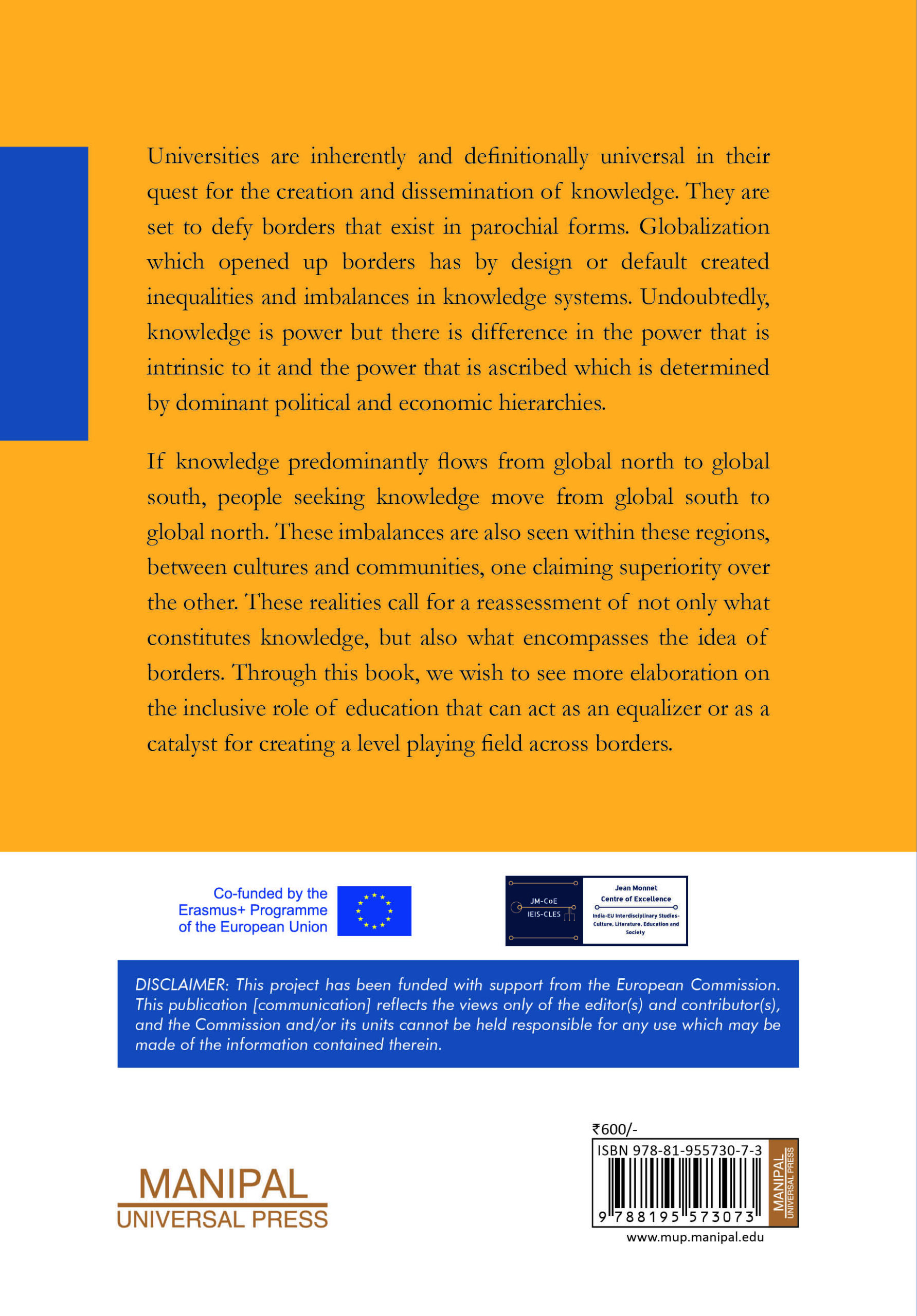
Universities are inherently and definitionally universal in their quest for the creation and dissemination of knowledge. They are set to defy borders that exist in parochial forms. Globalization which opened up borders has by design or default created inequalities and imbalances in knowledge systems. Undoubtedly, knowledge is power but the difference in the power that is intrinsic to it and the power that is ascribed which is determined by dominant political and economic hierarchies.<br><br>If knowledge predominantly flows from global north to global south, people seeking knowledge move from global south to global north. These imbalances are also seen within these regions, between cultures and communities, one claiming superiority over the other. These realities call for a reassessment of not only what constitutes knowledge, but also what encompasses the idea of borders. Through this book, we wish to see more elaboration on the inclusive role of education that can act as an equalizer or as a catalyst for creating a level playing field across borders.
Interested readers may write to us at mup@manipal.edu about purchasing the book.
International Edition available on |
South Asia Edition available on |
| Format |
|---|
Customer Reviews
There are no reviews yet.
Related products
-
COVID19: A Multidimensional Response
₹2,200.00Editors: N Udupa, Raviaraja NS, Chiranjay Mukhopadhya,
COVID-19 disease is caused by the SARS-CoV-2 virus, first detected in November-December 2019 in Wuhan, China. Thus far, more than 7 million people have been infected with the novel coronavirus across the globe, and the count is increasing with every passing day. Even though it causes severe respiratory problems, the majority of patients show mild symptoms, and pathogenesis is under investigation. Although several drugs are being developed and many of them are undergoing clinical trials, currently there are no approved drugs/vaccines to cure this disease. Personal hygiene and social distancing are important means to prevent the spread of this disease. With the advancements in scientific research, humankind is hoping to find a potent drug/vaccine for this disease at the earliest. The health care professionals and scientific community are at their maximum in combating this viral infection. In this book, an attempt is made to compile various aspects of COVID-19 in a single platform, which include aetiology, epidemiology, its clinical manifestations, diagnosis, pathological, clinical and therapeutic facets, comorbidities, risk factors, and the essential precautionary measures. This book comprises around 29 chapters contributed by various experts from research and clinical backgrounds.
Interested readers may write to us at mup@manipal.edu about purchasing the book.
Also available on
-

Geoffrey Bawa – A Conscious Perception
₹650.00This book is all about giving the readers a peek view into the life of Geoffrey Bawa; Sri Lanka’s most famous architect… a book that reveals an insight into his work through his most famous projects accompanied by beautiful hand drawn illustrations. Alluring and simply authentic, these self-narrative illustrations are a result of a personal experience. This book will give readers an understanding of how successfully Geoffrey Bawa had inculcated spaces, vistas and landscape with that of the built environment bringing about a touch of Modern Tropism and fusing it together with the rich culture and traditions of Sri Lanka.
Interested readers may write to us at mup@manipal.edu about purchasing the book.
Also available on
-

Linear Algebra with Applications
₹650.00Linear Algebra with Applications portrays selected articles published earlier by Prof Ravindra B Bapat in various reputed journals. This volume published in honour of Prof Bapat, on the occasion of his 60th birthday, consists of his original research articles written in the area of (i) Permanent, Determinant and their applications, (ii) Non-negative Matrices, (iii) Matrix Methods in Statistics and Graph theory, and (iv) Generalized Inverses of a Matrix. Starting with an article A Generalization of a Theorem of Ky Fan on Simplicial Maps, his first article published in 1980, several articles probing the properties of permanent and determinant, characterization of generalized inverses, spectral properties of graphs, and applications of matrix methods in statistics are compiled in this volume. The articles selected in this book will certainly inspire the young linear algebraists and provide several matrix techniques to solve different problems in the area of applied linear algebra.
Interested readers may write to us at mup@manipal.edu about purchasing the book.
Also available on
-

Childhood Cancer
₹185.00Authors: H S Ballal, P D Gupta
Childhood Cancer is a major medical problem in most of the societies of the modern world. Though enough literature is available on the subject, it is not easily intelligible to common people. An ordinary parent whose ward is affected by any form of childhood cancer would beat a loss without the basic information. This book is aimed at educating a non-professional who wishes to grasp the problem in detail and in a simple way. The book primarily deals with the signs and symptoms of cancer in children which enable early detection. It is written in a lucid manner to remove the myth among parents that diagnosis of cancer in children amounts to a death sentence. Many of the childhood cancers, if detected early, can be cured completely, and the patients can live the rest of their lives like any other normal people. The book is an attempt to create this awareness among parents through proper information about the disease. Further, the book would also serve as a manual for MBBS students and professionals in other fields for primary treatment and management of the childhood cancer patients.
Interested customers may write to us at mup@manipal.edu about purchasing the book.
Also available on
-

Transformation Beyond Sight
₹395.00Author: Jibu Thomas
Transformation Beyond Sight is a gripping narrative of the author’s experience in the hospital administration of Kasturba Hospital (KH), Manipal. As an experiential account, the present book provides insights into the thoughts, concerns, and apprehensions of prospective hospital administrators, and spotlights the vital role played by a hospital administrator in the day-to-day operations of KH, which is also an advanced healthcare facility.This book draws attention to the transformational quality of the author’s experiences to emphasize that the evolution in leadership and management of the teaching hospital went hand-in-hand with the transformation of the author’s administrative skills, and his own persona as a diligent administrator. The biographical undertone also provides an insight into the complex and dynamic healthcare environment, alongside the competencies, creativity, and mindfulness necessary for an administrator. This book narrates a hospital administrator’s engagements with the traditional processes and his attempts to bring about effective changes in the management and monitoring of operations of KH and the overall management of a healthcare facility.
Interested readers may write to us at mup@manipal.edu about purchasing the book.
Also available on
-
Legends of Travancore – A Numismatic Heritage
₹1,250.00The Kingdom of Travancore in the Southern part of India was a native state in British India which was well known for its progressive outlook. Its enlightened royalty ruled the country as Sree Padmanabha Dasa. They had in place a well oiled administrative mechanism that implemented various programs and reforms, resulting in an overall development of Travancore. Though Travancore was under the colonial rulers, there was a well-orchestrated administrative machinery for coinage. Coins were minted as per the specifications ordered by the periodically issued Royal Proclamations. It is creditable that Travancore retained its independence in its functioning to a large extent. This book is an insight into the coins of Modern Travancore (from 1729 AD) which not only reflects the religious beliefs of the rulers, but also sketches the socio-political atmosphere of the period. Dr Joseph Thomas hailing from Thiruvananthapuram, is a Professor of Urology at Manipal University in India. His passion for collecting coins developed into a serious numismatic pursuit. His special area of interest is the study of the history of Venad and Travancore. His detailed study of the Travancore coins and the various related issues give an insight into the rich numismatic heritage of modern Travancore. He is a Life Member of the Philatelic and Numismatic Association of Thiruvananthapuram and a Life Member of the South Indian Numismatic Society, Chennai.
Interested readers may write to us at mup@manipal.edu about purchasing the book.
Also available on
-

Pharmaceutical Consumer Complaints: A Guide to Academia and Pharmaceutical Industry
₹795.00Editors: Girish Pai Kulyadi, Muddukrishna B S, Richa Ajay Dayaramani
This book is an excellent guide in analyzing consumer complaints and will aid the students who are yet to gain industry experience. It is necessary for resolving consumer complaints in pharmaceutical industry where such concerns are frequently received. The case studies provide a vivid description of defects that will help identify the nature of the issue, possible root cause of such complaints, and subsequent remediation.
Interested readers may write to us at mup@manipal.edu about purchasing the book.
Also available on
-
Ayurvedic Inheritance- A Reader’s Companion
₹650.00Author: M S Valiathan
In ancient India, learning spanned four quarters of one’s life. Learning was sought from the teacher, from one’s individual effort, from fellow students and in the last quarter, from the school of life itself. This book belongs to the third quarter for students of Ayurveda regardless of their background in medicine, science, or humanities. Apart from topics in the eight branches of Ayurveda, the book also deals with Ayurvedic Biology which seeks to study the concepts and procedures of Ayurveda with the tools of modern biology. M S Valiathan is a National Research Professor of the Government of India. He is a medical graduate from the University of Kerala and completed his postgraduate training in general surgery from the University of Liverpool and other hospitals in the UK. He did his specialisation in cardiac surgery from the Johns Hopkins and Georgetown University Hospitals in the US. He was a cardiac surgeon for over three decades. His shift to Ayurvedic studies resulted in the publication of three volumes on Caraka, Susruta and Vagbhata, and an Introduction to Ayurveda. The Department of Science and Technology set up a Task Force in Ayurvedic Biology under his chairmanship to promote research in the nascent discipline.
Interested readers may write to us at mup@manipal.edu about purchasing the book.
International Edition available on South Asia Edition available on
Be the first to review “Reimagining Border in Cross-border Education”
You must be logged in to post a review.